You just typed a caption for your puppy’s photo and paused. Is it “too cute” or “to cute”? This tiny mix-up trips up even confident writers, and autocorrect doesn’t always catch it.
Getting too cute vs to cute wrong can make a sweet caption look careless. The good news is the rule is simple once you see it clearly, and you’ll never second-guess it again.
Quick Answer
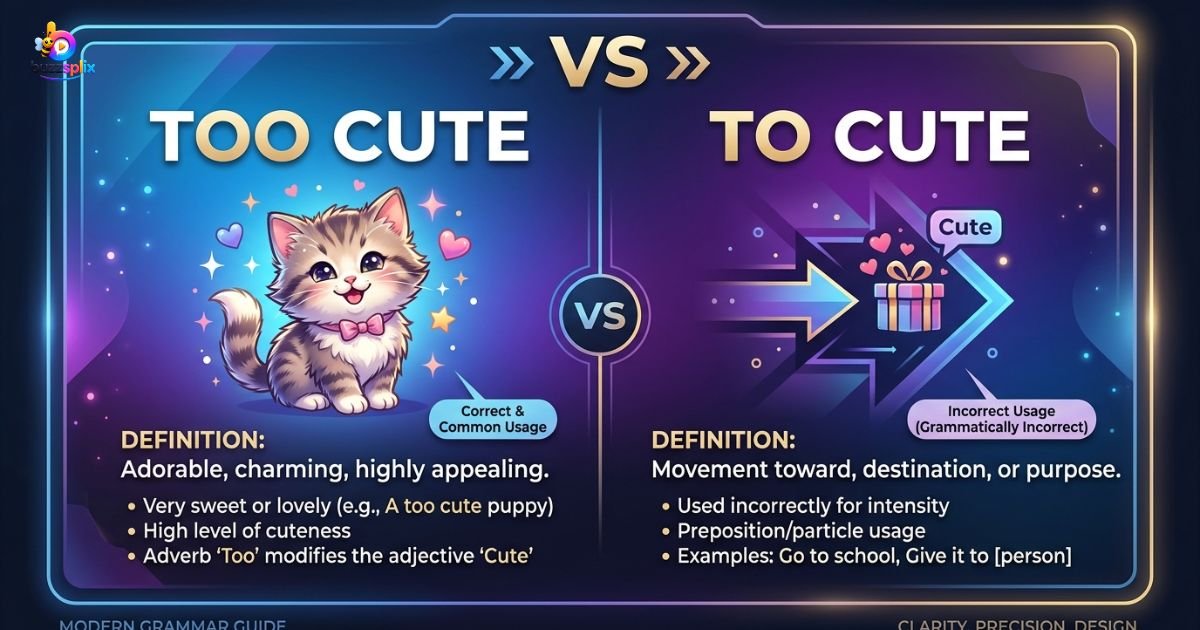
“Too cute” is correct. The word too means “excessively” or “also,” so it fits when describing something adorable beyond normal levels.
“To cute” is a spelling mistake because “to” is a preposition or part of an infinitive verb, and it can’t describe an adjective like “cute.” Whenever you’re praising something adorable, “too cute” is the phrase you want.
Too Cute vs To Cute at a Glance
Here’s a simple breakdown to keep both words straight:
| Feature | Too Cute | To Cute |
| Grammatically correct | Yes | No |
| Function | “Too” is an adverb meaning “excessively” | “To” is a preposition, not an adverb |
| Example | “That kitten is too cute!” | Not a valid phrase |
| Common use | Compliments, texting, captions | Typing error |
If you remember nothing else, remember this: cute is a description, and only “too” can describe a description.
What Does “Too Cute” Mean?
“Too cute” describes something so adorable it goes past the usual amount of cute. It’s an intensifier phrase, meaning “too” boosts the word “cute” to show a higher degree.
You’ll hear it used for:
- Babies, puppies, and kittens
- Small or miniature versions of everyday items
- Outfits, accessories, or handwriting
- Someone’s personality or behavior
The phrase almost always carries warmth. It’s rarely neutral and almost never harsh, which is part of why it shows up so often in casual conversation and online captions.
Why Is “To Cute” Incorrect?
“To cute” doesn’t work grammatically because “to” isn’t built to modify adjectives. In English, “to” has two main jobs:
- It points toward a direction, place, or recipient (“go to the store,” “give it to her”).
- It pairs with a verb to form an infinitive (“to run,” “to learn,” “to smile”).
“Cute” is an adjective, not a place, person, or verb, so “to” has no grammatical role to play in front of it. When people write “to cute,” it’s almost always a typing slip rather than an intentional word choice. Spellcheck tools sometimes miss it because “to” is a correctly spelled word, just the wrong one for this context.
To vs Too: Understanding the Difference
Since this mix-up comes from confusing two short, similar-looking words, it helps to separate them clearly.
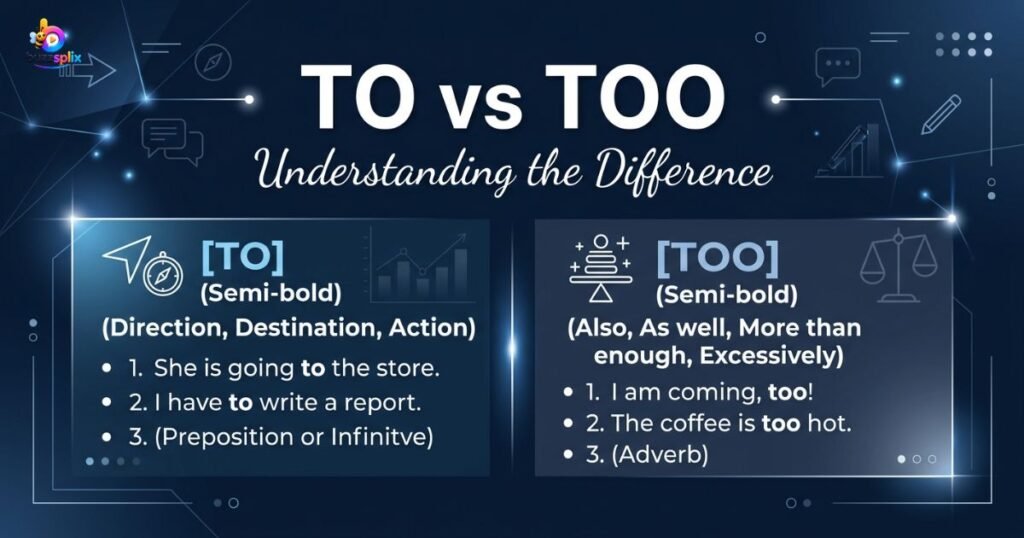
To functions as:
- A preposition showing direction or connection (“walk to school”)
- Part of an infinitive verb (“I want to leave”)
Too functions as:
- An adverb meaning “excessively” (“too loud,” “too cute”)
- An adverb meaning “also” (“I’m coming too”)
A quick trick: if you can replace the word with “also” or “excessively” and the sentence still makes sense, you need too with two O’s. If you’re describing motion, direction, or pairing it with a verb, use to with one O.
How to Use “Too Cute” Correctly
“Too cute” works as a standalone exclamation or as part of a larger sentence. Here’s how it typically fits:
- As a reaction: “Too cute!”
- Before a noun with “for”: “That sweater is too cute for words.”
- With a comparison: “The puppy is too cute to ignore.”
- In a compliment to a person: “You’re too cute.”
Grammatically, “too” sits right before the adjective it’s intensifying. There’s no need for extra words in between.
What Does “You’re Too Cute” Mean?
“You’re too cute” is a common compliment, usually said with affection or playful teasing. Depending on tone, it can mean:
- The person’s appearance or expression is adorable
- Their behavior or personality is endearing
- Someone finds a comment or gesture charming, sometimes bordering on funny
Context and tone matter here. Said warmly, it’s a genuine compliment. Said with a smirk, it can lean toward playful sarcasm, similar to saying “you’re something else” when someone does something silly but likable.
Too Cute Meaning in Texting and Social Media
In texting and social captions, “too cute” often gets shortened or stylized, but the meaning stays the same. Common variations include:
- “too cuteee” (stretched for emphasis)
- “too cute 🥺” (paired with an emoji for tone)
- “TOO CUTE” (all caps for enthusiasm)
These informal versions are fine for casual platforms like Instagram or texting, but the standard spelling “too cute” is still the correct base form. Save the stylized versions for casual settings, not professional writing.
Examples of “Too Cute” in Sentences
Seeing the phrase in different contexts makes it easier to use naturally:
- “The baby’s laugh is too cute; I can’t handle it.”
- “This mug shaped like a cat is too cute to use for coffee.”
- “Her handwriting is too cute, it looks like a font.”
- “He’s too cute when he tries to act serious.”
- “The socks in the kids’ section are too cute to pass up.”
Notice that “too cute” can attach to people, objects, sounds, or even behavior. It’s flexible as long as the thing being described has some adorable quality.
Common Mistakes People Make
Beyond writing “to cute” instead of “too cute,” a few related errors show up often:
- Confusing “too” with “two.” These sound identical but mean completely different things. “Two” is a number.
- Overusing “too” for emphasis instead of “very” or “so.” “Too cute” technically implies excess, though in casual speech it’s used loosely as a compliment rather than a literal complaint.
- Dropping the second O. Autocorrect sometimes shortens “too” to “to” if you’re typing fast, so a quick proofread helps.
- Using “to” before an adjective in other phrases, like writing “to funny” or “to tired” instead of “too funny” or “too tired.” The same rule applies across all of these.
Similar Expressions to “Too Cute”
If you want variety in your writing, these phrases carry a similar meaning:
- Adorably sweet
- Ridiculously cute
- Overly adorable
- Impossibly cute
- Heart-meltingly cute
These alternatives work well when “too cute” starts to feel repetitive in longer pieces of writing, like product descriptions or social captions.
Why People Confuse To and Too
The mix-up usually comes down to speed and sound, not a lack of grammar knowledge. Both words are pronounced the same way, and “too” is just “to” with one extra letter, which makes it easy to skip while typing quickly.
Texting and social media also encourage fast, low-effort typing where small errors slip through unnoticed. Over time, seeing the error repeated in captions or comments can make it look more familiar than it should, even though it’s still incorrect.
Can “Too Cute” Ever Be Negative?
In rare cases, “too cute” can carry a mildly critical tone, especially in creative or design contexts. For example, someone might say a marketing campaign is “too cute,” meaning it tries too hard to be clever or whimsical instead of being clear and effective. In everyday conversation about people, pets, or objects, though, “too cute” is almost always positive. The negative use is mostly limited to critiques of style, tone, or design choices.
Mini Grammar Quiz
Test yourself with these quick questions:
- “That puppy is _____ cute for words.” (to / too)
- “I’m going _____ the store, and I’m bringing snacks _____.” (to / too)
- “She looked _____ cute in that jacket.” (to / too)
Answers: 1. too, 2. to, too, 3. too
If you got all three right, you’ve got the rule down.
Frequently Asked Questions
Is it too cute or to cute?
“Too cute” is the correct spelling. “To cute” is a common typing error, since “to” cannot describe an adjective like “cute.”
What does too cute mean?
It means something is extremely or excessively adorable, often used as a warm compliment for people, pets, or objects.
Is too cute grammatically correct?
Yes. “Too” is an adverb that intensifies the adjective “cute,” which follows standard English grammar rules.
Can I use too cute in formal writing?
It’s best kept casual. In formal writing, consider alternatives like “remarkably endearing” or “exceptionally charming” instead.
What does you’re too cute mean?
It’s typically a compliment about someone’s appearance, personality, or a charming thing they did or said, often affectionate or playful in tone.
Conclusion
The rule behind too cute vs to cute comes down to one simple check: “too” means excessive or also, while “to” points toward direction or pairs with a verb.
Since “cute” is an adjective, only “too” can correctly describe it. Next time you’re captioning a photo or complimenting someone, you’ll know exactly which word to use, no second-guessing required.