You’ve typed it a hundred times and second guessed it every single time. Is it capital or capitol? One letter changes the whole meaning, and autocorrect won’t save you here.
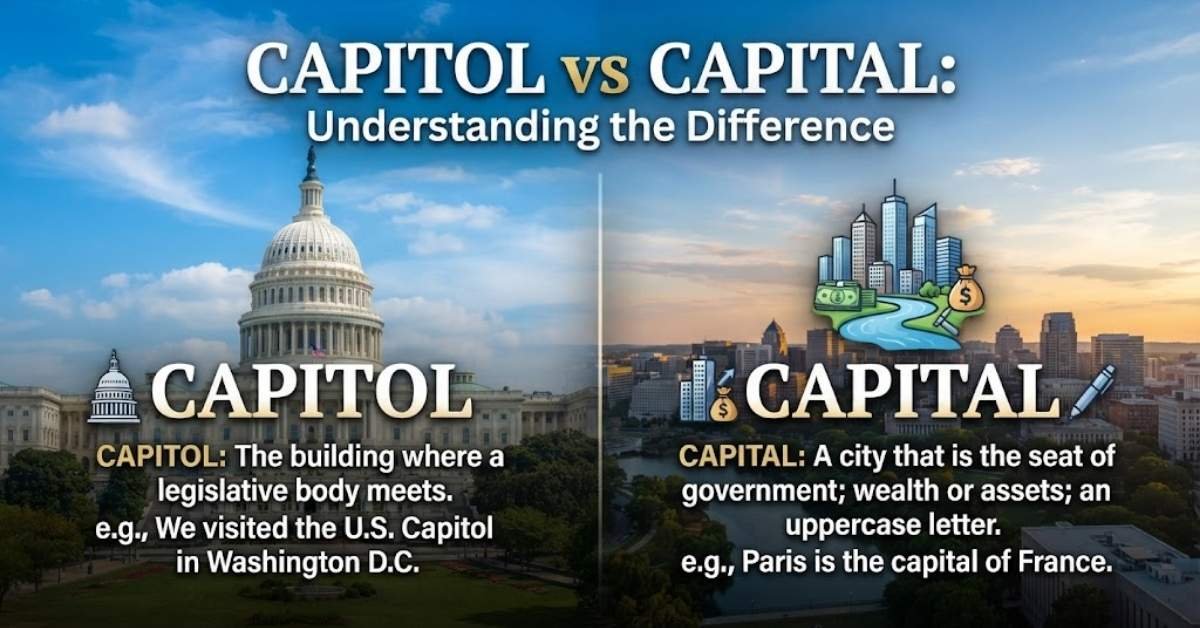
Here’s the short version. Capital covers money, main cities, and uppercase letters. Capitol is strictly about the building where lawmakers meet. Keep reading and you’ll never mix them up again.
Quick Answer
Think of it this way: capitol has one narrow job. It refers to a government building, usually where legislative work happens. That’s it. No side meanings, no extra baggage.
Capital, on the other hand, is the workhorse of the two. It handles money, wealth, business assets, capital letters, a capital city, and even capital punishment. One spelling, five or six different uses.
Examples:
- The US Capitol sits in Washington, D.C.
- Paris is the capital of France.
- She raised startup capital for her small business.
- Start every sentence with a capital letter.
The Origin of Capital and Capitol

Both words trace back to Latin, which explains why they look so similar. Capital comes from caput, the Latin word for “head.” Makes sense when you think about it. A capital city is the “head” of a country, and capital letters sit at the head of a sentence.
Capitol has a completely different backstory. It comes from Capitolium, the name of a temple on Capitoline Hill in Ancient Rome. That temple was dedicated to Jupiter and served as a center of Roman government and religious life. Fast forward a couple thousand years, and Americans borrowed that name for their own government buildings.
So even though they sound like twins, these two words grew up in totally different neighborhoods. One is about importance and “headness.” The other is a direct nod to Roman history.
British English vs American English Spelling
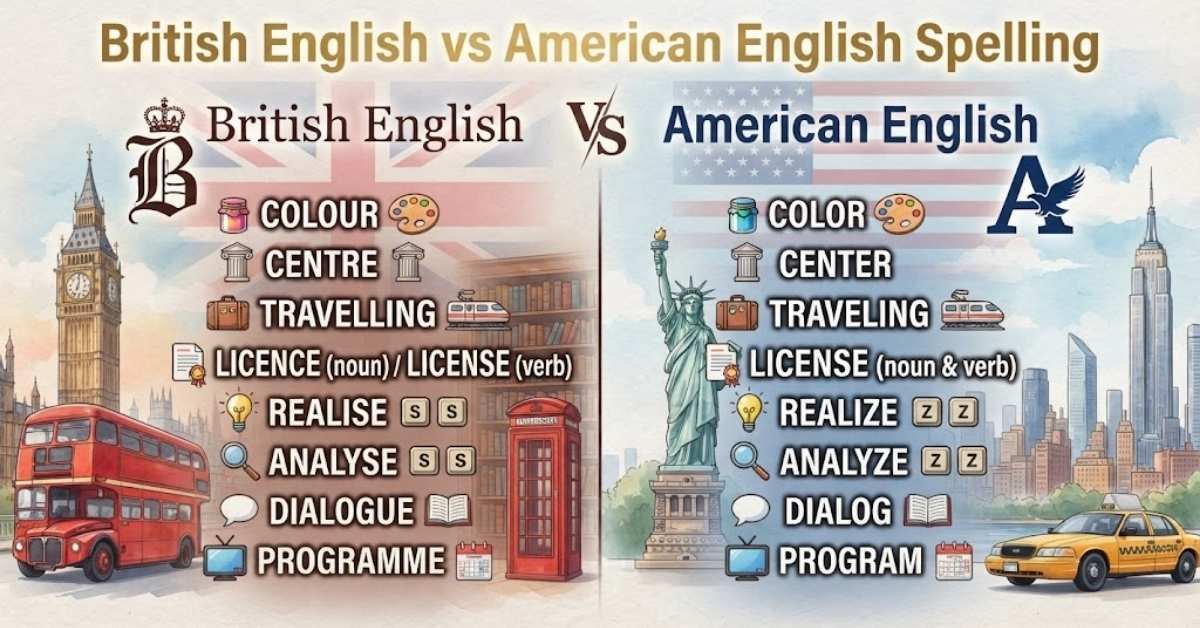
Here’s something that trips up a lot of English learners. This isn’t a British English versus American English thing at all. Both spellings exist in UK English and US English with the exact same meanings.
The difference isn’t regional, it’s contextual. If you’re talking about a government building where officials gather, you write capitol. If you mean anything else, money, a city, letters, you write capital. That rule holds true whether you’re writing in London or Los Angeles.
A lot of confusion happens because British writers rarely need the word capitol at all. The UK doesn’t have a building called a “Capitol.” So British speakers default to capital almost everywhere, and that habit sometimes bleeds into how they write about American topics.
Capital or Capitol When Referring to Money
When it comes to finance, business, and the economy, the answer is always capital. No exceptions here. Whether you’re talking about financial assets, working capital, or human capital, the “o” version never shows up.
Investors and companies throw this word around constantly. A firm might need capital investment to grow. A founder might chase startup capital from an investor. Even your own skills and experience count as human capital, since businesses see people as valuable assets too.
Examples:
- The company secured $2 million in capital investment.
- Working capital keeps the business running day to day.
- Employees are often called a firm’s most valuable human capital.
Capital or Capitol Letters
This one’s easy once you remember the trick. Uppercase letters are always capital letters, never capitol letters. There’s no such thing as a “capitol letter” anywhere in the English language.
Think back to that Latin root, caput, meaning head. A capital letter sits at the “head” of a word or sentence. That little memory hook makes the rule stick instantly, and you’ll stop second guessing yourself in emails and essays.
Examples:
- Always begin a sentence with a capital letter.
- Proper nouns like “London” or “Sarah” need a capital letter.
- Acronyms are usually written in capital letters, like NASA or FBI.
Capital or Capitol Punishment
Here’s another spot where people slip up. The death penalty is called capital punishment, spelled with an “a,” not an “o.” The word “capital” here means “involving loss of life” or “serious,” a meaning that dates back centuries.
Capital punishment remains one of the most debated topics in political news today. Some countries have abolished capital punishment entirely, while others still enforce it for certain crimes. Either way, the spelling never changes based on where the debate happens.
Examples:
- Several countries have abolished capital punishment in recent decades.
- The trial could result in capital punishment if convicted.
- Public opinion on capital punishment varies widely across cultures.
Capital or Capitol Hill
This phrase confuses almost everyone, and honestly, that’s fair. Capitol Hill refers to the physical location in Washington, D.C., where the United States Capitol building stands. It’s spelled with an “o” because it’s directly named after the Capitol building itself.
But here’s the twist. People also use “Capitol Hill” loosely to describe Congress as an institution, the way “Wall Street” refers to the finance industry rather than an actual street. So when someone says a bill is “moving through Capitol Hill,” they mean it’s working through the legislative process, not that it’s physically walking around a hill.
Capital or Capitol Equipment
Businesses talk about capital equipment all the time, and this always uses the “a” spelling. Capital equipment refers to large, long-term assets like heavy machinery, tools, or machines that a company invests in to run its operations.
This term connects directly back to capital investment and capital budget planning. Companies don’t buy this stuff casually. A capital budget usually gets mapped out months or years in advance, since capital equipment purchases are expensive and meant to last.
Examples:
- The factory upgraded its capital equipment last quarter.
- Buying new machines falls under the company’s capital budget.
- Heavy machinery counts as a long-term business asset.
Capital and Capitol in a Sentence
Sometimes the fastest way to learn is by seeing both words side by side. Here’s how they play out in real writing:
- The governor visited the state capitol to sign the new bill.
- Cairo is the capital of Egypt.
- Lawmakers gathered inside the Capitol building for the vote.
- She needs more capital to expand her business.
Notice how “capitol” only ever shows up when a physical building or Capitol Hill area is involved. Everywhere else, “capital” does the heavy lifting.
Common Mistakes with Capital or Capitol
The most frequent slip up? Writers use “capitol” when they actually mean a capital city. It’s an honest mistake, since both words sound identical when spoken aloud. But readers and search engines notice the difference, and so do editors.
Another common error involves capital punishment. People sometimes spell it “capitol punishment,” maybe because the topic involves government and law, so the brain jumps to the building spelling. It’s a homophone trap, plain and simple.
Corrections:
- Wrong: The capitol of Japan is Tokyo. Right: The capital of Japan is Tokyo.
- Wrong: He supports capitol punishment. Right: He supports capital punishment.
- Wrong: She raised capitol for her startup. Right: She raised capital for her startup.
Capital or Capitol in Everyday Examples
Understanding grammar rules is one thing. Seeing them applied across real writing situations makes the lesson stick.
Emails
Professional writing demands accuracy, and nothing undercuts credibility faster than a misspelled word in a business email. If you’re emailing a colleague about funding, you’d write “we need additional capital for this project,” never “capitol.” Keep it a win win for both sides by getting the spelling right the first time, so nobody has to correct you later.
News
News writing relies heavily on precision, especially around political news. Journalists covering Capitol Hill or a state legislative building need to nail this distinction every time, since a single typo can confuse readers about whether a story is about money or government.
Business
Business reports frequently reference capital investment, working capital, and capital equipment. Getting this wrong in a formal report signals carelessness, and readers, especially investors, notice sloppy language fast.
Academic Writing
Academic essays covering topics like government, history, or economics use both words constantly. A student writing about the Roman government might reference the original Capitolium, while an economics paper would lean entirely on capital for financial discussion.
Capital or Capitol – Google Trends & Usage Data
If you check Google Trends, search interest for “capital” massively outpaces “capitol” worldwide, and that makes sense. Capital covers far more ground: cities, money, letters, punishment. Capitol stays niche, spiking mainly around US elections, political news, or events tied to the US Capitol building.
This usage data also shows something interesting. Searches for “capital vs capitol” tend to spike after major news events involving Capitol Hill, which tells us people actively look this up when they’re confused by something they just read or watched. That’s exactly the kind of general usage versus specific usage pattern worth understanding if you write online content regularly.
Capital vs Capitol – Comparison Table
| Aspect | Capital | Capitol |
| Meaning | Money, main city, uppercase letters | Government building |
| Word Origin | Latin “caput” (head) | Latin “Capitolium” (Roman temple) |
| Common Use | Business, finance, grammar | Politics, government, legislation |
| Example | Capital of France is Paris | The US Capitol is in Washington, D.C. |
| Frequency | Used far more often | Rare, context specific |
Conclusion
At the end of the day, this comes down to one simple filter. Ask yourself: am I talking about a government building? If yes, it’s capitol. If no, it’s almost always capital. That one question solves 95 percent of the confusion.
Keep that caput to Capitolium origin story in your back pocket too. It’s a small detail, but it makes the rule stick long after you’ve forgotten every other grammar tip you’ve read this year.
FAQs
Is capital or capitol used for money?
Capital is always correct when discussing money, wealth, or financial assets. “Capitol” never applies to finance in any context.
Is it capital or capitol letters?
It’s always capital letters. “Capitol letters” isn’t a real term, no matter how official it sounds.
What does capitol mean?
Capitol refers to a government building, specifically one used for legislative purposes, like the US Capitol or a state capitol.
Can capital and capitol be used together?
Yes, in certain sentences both can appear, such as “The capital city houses the state capitol building.” They serve different roles even within the same sentence.
Is capital punishment spelled with capitol?
No. It’s always capital punishment, spelled with an “a.” This is one of the most commonly misspelled versions of the word.
Is Capitol used outside the US?
Rarely. The term is mostly tied to American English and the United States Capitol. Other countries typically use different terms for their government buildings.