You’re typing a sentence and your spellchecker underlines “modelled” in red. Or it flags “modeled” instead. So which one is right?Both are correct. Modeled is the standard spelling in American English, and modelled is the standard in British English. The meaning, grammar, and pronunciation don’t change at all.
This guide shows you when to use each one and why the split exists. You’ll also see how it plays out in fashion, science, engineering, education, and business.
Modelled
Modelled is the past tense of model and its past participle in UK English. It uses the double L. You’ll spot it in British newspapers, Australian websites, and most Canadian writing.
Modeled
Modeled is the same verb with a single L. It’s the everyday choice for US websites, American textbooks, and US business writing.
Modelled or Modeled: Quick Answer ✅

Use modeled if your readers are mostly American. Use modelled if they’re British, Australian, or Canadian. Then stick with your pick from the first line to the last.
Neither one is a typo. Think of it like choosing between “color” and “colour.” Your target audience decides, not the dictionary.
Examples
- American: The designer modeled her new jacket at the launch.
- British: The designer modelled her new jacket at the launch.
- American: He modeled the bridge in advanced software before construction began.
- British: He modelled the bridge in advanced software before construction began.
What Does Modeled/Modelled Mean?
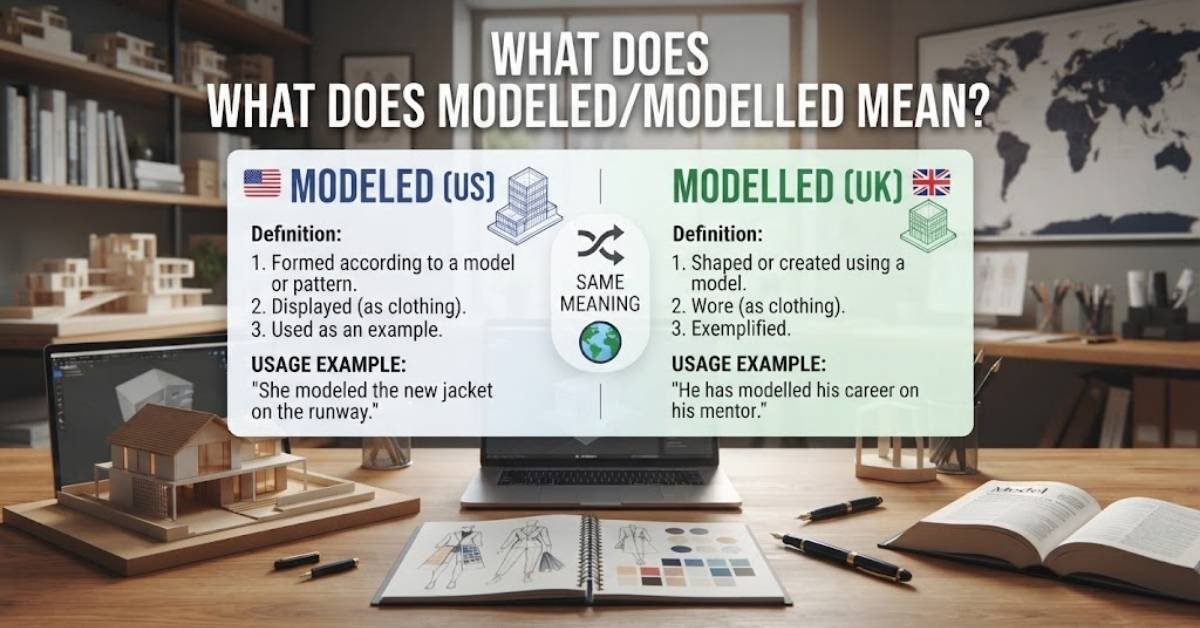
Both spellings come from the verb model. It means to create a model, to shape something, or to pose as a model. It can also mean to imitate a behavior or to demonstrate how something works.
That range is why the word shows up everywhere. A tailor models a suit, a teacher models good writing, and an analyst models next year’s sales.
Examples
- She modeled clothes for a fashion magazine last spring.
- The teacher modeled calm communication for her students.
- Researchers modelled how the virus might spread through a city.
- He modelled the clay into a small horse.
Origin of the Word Model
The word traces back to the Latin modulus, a small measure. Italian turned it into modello, meaning a pattern or a representation of something bigger. French then passed it to English in the late 1500s.
The etymology explains the meaning. A model has always been a smaller stand-in for the real thing, a pattern you can study or copy.
The verb forms came later, and that’s where the spelling fork appeared. English writers on both sides of the Atlantic started adding endings, and they didn’t agree on the L.
Why Are There Two Spellings?
Blame language variation. When American writers pushed for simpler spelling in the 1800s, Noah Webster’s dictionaries backed shorter forms. British publishers mostly kept the older doubled forms.
The result is two sets of spelling conventions that both work. Neither side “fixed” a mistake. They just went different ways.
American English Rule 🇺🇸
American spelling rules say you don’t double the final consonant when the last syllable is unstressed. In “model,” the stress falls on the first syllable, so the L stays single. That gives you modeled and modeling.
British English Rule 🇬🇧
British rules double the final L after a single vowel, even when the syllable is unstressed. So model becomes modelled and modelling. It’s a steady spelling pattern you’ll see across many verbs.
Modelled vs Modeled: Core Difference
There’s only one difference, and it’s the letter L. Everything else matches: same meaning, same grammar, and same pronunciation.
The gap is about regional preference, not correctness. That makes the choice easy once you know who’s reading.
Comparison Table
| Feature | Modeled | Modelled |
| Spelling | Single L | Double L |
| Region | United States | UK, Australia, Canada |
| Past tense | Yes | Yes |
| Past participle | Yes | Yes |
| -ing form | Modeling | Modelling |
| Meaning | Identical | Identical |
How to Pronounce Modelled and Modeled
Here’s the good news. Both words sound the same, so you never have to think about it out loud. The extra L is only a spelling detail.
Say “MOD-uld” and you’ve got it. Americans tend to say the first vowel like “ah,” and Brits say it a bit shorter, but that’s an accent thing, not a spelling thing.
Pronunciation
- US: MAH-duld
- UK: MOD-uld
- Stress falls on the first syllable in both.
Modeled/Modelled in Fashion
Fashion is the first place most people meet this word. A fashion model wears designer clothing on the runway or in a clothing campaign. The verb describes that exact job.
Editors care about spelling here, especially at a fashion magazine with a set house style. Pick the version that fits the publication.
American English
A US outlet would write: “She modeled the new Versace collection during fashion week.” Same for fashion brands with American audiences.
British English
A UK outlet would write: “She modelled the new Versace collection during fashion week.” Only the double L changes.
Example Sentences
- The outfits were modeled by three newcomers. (US)
- The campaign was modelled by a Milan-based team. (UK)
- He has modeled for several fashion brands. (US)
- She modelled at London Fashion Week. (UK)
Modeled/Modelled in Science
Scientists use models to understand things they can’t test directly. A model is a simplified version of a real system, built to make a prediction. That’s why the word is everywhere in research papers.
Journals follow their own style, so researchers should check submission guidelines first. Most American journals want modeled, and most British ones want modelled.
Examples
- Researchers modeled climate scenarios for the next 50 years. (US)
- Scientists modelled population growth in coastal cities. (UK)
- The team modeled climate patterns using satellite data. (US)
- Scientific modeling helped them test ideas safely. (either)
Modeled/Modelled in Engineering
Engineers build digital models before they pour any concrete. It saves money, and it catches problems early. Tools like AutoCAD make that routine work.
The verb pops up in reports, proposals, and testing notes. Consistency matters, because these documents get read by clients and regulators.
Examples
- The engineer modeled the bridge in AutoCAD before construction. (US)
- They modelled the structure under heavy wind loads. (UK)
- The architect modeled the building in 3D. (US)
- The team modelled the software interface first. (UK)
Modeled/Modelled in Education
Teachers use this word in a very human way. A good teacher shows a skill first, then lets students try it. That’s called modeling, and it’s a proven learning technique.
You’ll see it in lesson plans, training manuals, and school reports. The spelling depends on the country, not the subject.
Examples
- The instructor modeled good classroom behavior all term. (US)
- The teacher modelled clear communication during group work. (UK)
- She demonstrated and modeled the technique twice. (US)
- Students learn faster when the method is modelled first. (UK)
Modeled/Modelled in Business
Business teams live on models. Analysts build them to see where a company might land next year. It’s less glamorous than the runway, but it’s the same verb.
Reports, pitch decks, and investor updates all use it. Your spelling should match the region you’re writing for.
Businesses use models to forecast performance and make decisions.
A forecast is only as good as its historical data. Analysts feed past numbers into a model and test economic scenarios to guide decision making.
This is where careless spelling hurts trust. A finance report that flips between spellings looks rushed.
Examples
- Analysts modeled revenue growth for the next quarter. (US)
- The company modelled three economic scenarios for 2027. (UK)
- We modeled financial forecasting using five years of data. (US)
- Team performance was modelled against last year’s targets. (UK)
Usage Around the World
English isn’t one fixed thing. Regional spelling shifts from country to country, and this word is a clear example. Here’s where each version rules.
United States 🇺🇸
US English uses modeled and modeling almost without exception. Style guides like AP and Chicago back it. If your American audience reads it, go with one L.
United Kingdom 🇬🇧
UK English uses modelled and modelling. British publications and UK style guides follow this rule. Double L is the safe choice here.
Australia 🇦🇺
Australian English follows the British pattern. You’ll see modelled in newspapers, universities, and government documents. Australian writers rarely use the single L form.
Canada 🇨🇦
Canada is the tricky one, since it mixes American and British habits. Most Canadian dictionaries and publishers prefer modelled. Still, check your style guide before you commit.
Which Spelling Should You Use? 🤔
Ask one question: who’s reading? Your audience targeting decides everything. Once you know your reader, the choice takes about five seconds.
Here’s a quick way to decide.
Use “Modeled” If:
- Your readers are mainly in the United States
- You follow an American style guide
- Your site targets US websites and search results
- Your editor asks for US English
Use “Modelled” If:
- Your readers are in the UK, Australia, or Canada
- You follow a UK style guide
- Your site serves a British audience
- Your client asks for British spelling
Considerations 🔍
Search demand matters too. Both spellings get searched, but people usually type the version they use at home. If you write for SEO, match the spelling your readers type.
Don’t try to rank for both on one page by mixing them. That confuses readers and hurts your editorial consistency.
Best Practice
Pick one spelling for the whole piece. Set your language in your CMS and your word processor. Add the choice to your writing style notes so every writer follows it.
If you cover both audiences, make two versions of the page. It takes a bit more work, but it reads cleaner.
Common Mistakes with Modelled and Modeled
Most spelling slips here come from doubt, not ignorance. People see both forms and assume one must be a spelling error. That’s the first trap.
Here are the three mistakes I see most often.
Mistake #1: Thinking One Is Wrong
Neither one is wrong. Correcting a British writer’s “modelled” to “modeled” isn’t a fix. It’s a change of dialect.
Mistake #2: Mixing Spellings
Writing “modeled” in paragraph one and “modelled” in paragraph six is inconsistent spelling. Readers notice it, even if they can’t say why. Avoid changing styles mid-article.
Mistake #3: Assuming Different Meanings
Some people think one spelling means “posed” and the other means “built.” That’s not true. The meaning never changes, so don’t hunt for a hidden difference.
Memory Tricks
Spelling rules are easier when you have a hook. Here are three short memory tricks that work. Use the one that sticks best for you.
Trick #1: America Uses One L
Picture one American flag, one L. America uses one L in modeled.
Trick #2: Britain Uses Double L
Think of the two lions on old British crests. Britain uses double L in modelled. Two lions, two Ls.
Trick #3: Meaning Never Changes
Whatever spelling you pick, the word does the same job. Meaning never changes, so you can relax about that part. Only the letters move.
Other Words That Follow the Same Pattern
Once you learn this rule, you’ll spot it everywhere. Many verbs ending in a single L behave the same way. It’s a handy spelling reminder.
| American | British |
| traveled | travelled |
| canceled | cancelled |
| labeled | labelled |
| modeled | modelled |
| fueled | fuelled |
Watch out for the odd one. “Cancelled” still shows up in American writing, so it’s one of the words where the rule is a bit leaky.
Modeling vs Modelling
The same split carries into the -ing form. Modeling is American, and modelling is British. The rule is identical, so if you remember one, you’ve got both.
You’ll also see the noun forms. “Modeling agency” in the US becomes “modelling agency” in the UK. A “model” itself stays the same everywhere.
Comparison Table
| Term | American English | British English |
| Past tense | modeled | modelled |
| Past participle | modeled | modelled |
| Present participle | modeling | modelling |
| Pronunciation | Same | Same |
| Meaning | Same | Same |
| Preferred region | US | UK, Australia, Canada |
Common User Queries
People ask the same handful of questions again and again. Here are the quick answers, straight from real search habits.
- Is modelled British English? Yes, it’s the standard British form.
- Is modeled American English? Yes, it’s the standard American form.
- Which spelling is correct? Both, depending on your region.
- How do you spell modeled in the UK? With a double L: modelled.
- Can I use both spellings? Not in the same piece.
- Which version is more common worldwide? It depends on the audience, but British-influenced regions use modelled, while the US uses modeled.
Conclusion
Modelled and modeled are two spellings of the same word. One belongs to British English, the other to American English. Neither is a mistake.Choose based on your reader, then stay consistent. That one habit does more for your writing than memorizing any rule.
Did this clear things up for you? Drop a comment with the word that still trips you up, and share this with a friend who keeps second-guessing their spelling. I’ll keep this guide updated as usage shifts.
FAQs
Do modeled and modelled mean the same thing?
Yes. They share the same meaning, grammar, and pronunciation. Only the spelling differs.
Which spelling is more common in the United States?
Modeled. American dictionaries and style guides list it first.
Which spelling is more common in the United Kingdom?
Modelled. British publishers use the double L consistently.
Can I use both spellings in one article?
No. Mixing them looks inconsistent. Pick one and use it throughout.
Which spelling should I use for my website?
Match your main audience. If most visitors are American, use modeled. If they’re British, Australian, or Canadian, use modelled.