Which one is right, honor or honour? Both are correct.Honor is the American English spelling. Honour is the British English spelling.The word meaning stays the same in both. It points to respect, dignity, and recognition. Your audience-based spelling choice is the only real decision you need to make.
Maybe you’ve typed “honour” in a cover letter and watched a red squiggly line jump out at you. Or you’ve sent an email to a client in London and wondered if your “honor” looked sloppy.You’re not alone. Plenty of writers freeze on this exact spelling, so let’s clear it up for good.
Quick Answer
Use honor if your readers live in the United States (US). Use honour if your readers live in the United Kingdom (UK), Canada, Australia, India, or most other Commonwealth countries.
Here’s the simple rule. The -our ending is British, and the -or ending is American.
Neither one is a typo. They’re spelling variants of the same word, and readers in each region expect their own version.
The Origin of Honor or Honour

The story starts with the Latin word honor. Romans used it for esteem, public office, and respect.
That Latin origin traveled into Old French, where the word appeared as honor, honur, and onur. English borrowed it after the Norman Conquest, and the spelling settled into honour for centuries.
Why does the etymology matter to you? Because the extra “u” came from French habits, not from Latin roots.
Here’s a fun twist. Some English scribes later tried to restore the Latin look and wrote honor again, but the French style won out in Britain.
How Noah Webster Changed American Spelling

Picture a young country in the early 1800s. It wanted its own identity, and that included its own language.
Enter Noah Webster, the famous American lexicographer. In his dictionaries, he pushed spelling reforms that trimmed extra letters and matched spelling to sound.
His American spelling simplification gave us removed “u” words like color, favor, and honor. He also gave us “center” and “defense,” though not every idea of his caught on.
Think of Webster as a tidy roommate. He cleared out the clutter, and Americans kept the cleaner version.
British English vs American English Spelling
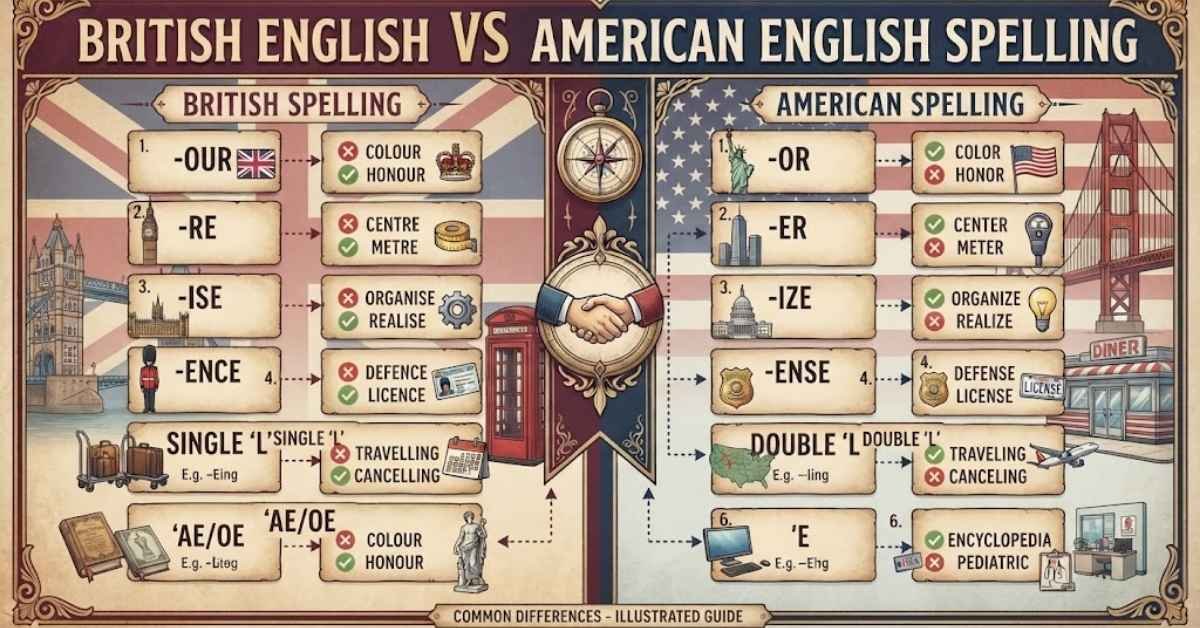
The British spelling conventions kept the French-flavored -our ending. Americans adopted the shorter -or ending across a whole family of words.
This is one of the most common spelling differences between the two versions. Once you spot the pattern, you can predict dozens of words without a dictionary.
Here are a few pairs you’ll see all the time:
- color vs colour
- favor vs favour
- valor vs valour
- neighbor vs neighbour
- humor vs humour
- behavior vs behaviour
Not every word follows the pattern, though. Words like “error,” “mirror,” and “actor” use -or in both versions.
Comparison Table
This table gives you a fast British vs American spelling comparison you can bookmark. Scan it whenever you feel unsure.
| Word | American English | British English | Meaning |
| Respect or esteem | honor | honour | Same |
| Hue | color | colour | Same |
| Support | favor | favour | Same |
| Courage | valor | valour | Same |
| Manner of acting | behavior | behaviour | Same |
| Friendly amusement | humor | humour | Same |
The honor vs honour comparison boils down to one letter. The same meaning carries through every row.
Which Spelling Should You Use?
Start with your readers, not with your own habit. Ask yourself where most of them live and which English spelling rules they learned at school.
If your audience is mostly American, choose honor. If it’s mostly from the UK, Canada, Australia, or India, choose honour.
Canada deserves a quick note. Canadian spelling mixes both systems, but “honour” is the standard choice there.
What about a mixed audience or a global audience? Pick one version and stick with it, because spelling consistency matters more than which side you choose.
Your style guide can settle the debate too. APA style and MLA style follow American spelling, while Oxford style leans British.
Spelling in Formal and Professional Writing
Formal writing raises the stakes, since small slips can chip away at your credibility. A wrong spelling won’t sink you, but a messy mix of both will.
Think about the setting you’re writing for:
- Academic papers: follow the journal’s or university’s guidelines.
- Legal documents: match the country’s legal norms. American legal texts use “honor,” while UK and Commonwealth contracts use “honour.”
- Resumes: mirror the spelling of the country where you’re applying.
- Emails: match your recipient’s region when you know it.
- Blog writing and published content: match your main readership.
Professional writing rewards attention to detail. Employers, editors, and clients notice when you keep one style from start to finish.
Common Mistakes with Honor or Honour
The biggest slip is mixing both spellings in one document. You write “honour” in paragraph one and “honored” in paragraph five, and readers spot it fast.
Another writing mistake comes from autocorrect. Your phone or laptop may flip “honour” to “honor” without asking.
Here are the common spelling errors worth watching for:
- Writing “honnor” or “honnour” with a doubled “n.”
- Using “honour” in a US-only publication.
- Adding the “u” to words that never take it, like “honorary.”
- Mixing “honoured” and “honored” in the same piece.
- Trusting the wrong language settings in your document editor.
Sound familiar? Most of these fixes take about thirty seconds once you know where to look.
Honor or Honour in Derived Words
Here’s where things get tricky. Some words built from honor or honour don’t follow the same rule.
Both versions drop the “u” in a few forms:
- Honorary
- Honorific
- Honorarium
Yet the British form keeps the “u” in others:
- Honourable (British) vs honorable (American)
- Honoured (British) vs honored (American)
- Dishonour (British) vs dishonor (American)
An honorific usage example is “Dr.” or “Sir.” That word carries no “u” anywhere, even in London.
Want a quick test? If the word ends in “-ary,” “-ific,” or “-arium,” skip the “u” in every country.
Honor or Honour in Everyday Examples
Real sentences beat rules, so let’s look at a few. Here’s how each version reads.
American English:
- “It’s an honor to meet you.”
- “She received an honor from her college for volunteering.”
- “We honored the veterans at Monday’s ceremony.”
British English:
- “It’s an honour to meet you.”
- “She received an honour from the university for her volunteering.”
- “We honoured the veterans at Monday’s ceremony.”
A few contexts show up again and again. Email examples often include lines like “I’d be honored to join your team” or “I’d be honoured to join your team.”
News writing uses the word in headlines about awards and ceremonies. An American paper might run “Local teacher earns top honor,” while a British one runs “Local teacher earns top honour.”
Social media writing leans casual, but the spelling still signals where you’re from. A post reading “Honoured to be part of this” tells followers you’re likely British, Canadian, Australian, or Indian.
Award recognition carries its own quirks. The US has the Medal of Honor, and the UK publishes the New Year Honours list.
Short and sweet, right? The rule holds up in every context.
Honor or Honour: Google Trends and Usage Data
Curious about which spelling people search for more? Google Trends can show you.
Trends reports search popularity on a relative scale from 0 to 100. It doesn’t give raw search counts, so it’s best for spotting patterns.
Regional search behavior tends to follow the spelling habits of each country. Searches for “honor” usually come from the US, while “honour” gets more attention across the UK and Commonwealth.
You can test this yourself in a minute. Open Google Trends, type in both words, and compare them by country and date range.
Why does it matter to writers? Because search trends hint at how your readers spell, which helps you match their expectations.
Keyword Comparison Table
This keyword comparison gives you a simple guide to intent and audience. Use it when planning SEO writing for different regions.
| Keyword variant | Main audience | Best for | Typical context |
| honor | US readers | American publications, US legal texts | Awards, military, education |
| honour | UK readers, Commonwealth | British publications, contracts in Canada, Australia, India | Honours lists, academic degrees, ceremonies |
| honor or honour | Global audience | Explainer articles, spelling guides | Search queries about differences |
Notice something useful here. A spelling guide like this one can naturally include both keyword variants, since readers search for both.
Setting Your Language Preferences
Fixing this problem in your tools saves you future headaches. Small tweaks to language settings can stop the constant flipping.
Here’s a quick checklist:
- Word processors: set the proofing language to English (US) or English (UK).
- Browsers: change the spell-check language in settings.
- Phone keyboards: add the right English variant.
- Grammar tools: select the correct dialect before you run a check.
Then reread your work before hitting send. A fast scan beats a red-faced correction later.
Why Spelling Choices Build Credibility
Readers judge you faster than you think. A polished, consistent draft signals care, and it builds credibility in writing.
Communication clarity also benefits. When your spelling matches your reader’s habits, nothing distracts them from your message.
Ever notice how a small typo can pull your attention away from a good idea? That’s the effect you avoid by choosing one style and sticking with it.
The Evolution of English Spelling
English language evolution never stops. Spelling keeps shifting as trade, technology, and culture push words around.
The internet has blurred the line between the two versions. Many British readers now see “honor” online every day, and many Americans see “honour” in British films and news.
Still, grammar rules and word choice in formal settings hold firm. So learn both versions, and switch to the right one when your audience calls for it.
Conclusion
Honor and honour mean the same thing. The difference is region: honor for the US, honour for the UK and most Commonwealth spelling traditions.Choose based on your readers. Then keep the same style from your first line to your last for strong spelling accuracy.
Have you ever mixed the two by accident? Share your story in the comments, and pass this guide along to a friend who could use it.
FAQs
Is it honor or honour?
Both are right. Use “honor” for American readers and “honour” for British and Commonwealth readers.
Do honor and honour mean different things?
No. They share the same meaning and pronunciation, so only the spelling changes.
Is honour correct in American English?
It’s understood in the US, but it looks like a British choice. Use “honor” in American publications, resumes, and legal texts.
Which spelling does Canada use?
Canada usually writes “honour,” along with “colour” and “favour.” Some other Canadian spellings follow American rules.
Why did Americans drop the “u”?
Noah Webster promoted simpler spelling in the early 1800s. His dictionaries helped the shorter forms spread across the United States.
Can I use both spellings in one article?
Avoid it. Pick one version and stay consistent from start to finish.
Do the words “honorary” and “honorific” have a “u” in British English?
No. They drop the “u” in both British and American English.Got another spelling question? Drop it in the comments, and I’ll cover it in the next update.