You’re typing up a listing for your camper, or maybe finishing a school essay about moving trucks, and your fingers freeze. Is it trailer or trailor? Spellcheck hasn’t flagged anything yet, but something feels off.
This tiny mix-up trips up more people than you’d expect, and getting it wrong in a resume, ad, or business document can quietly hurt your credibility. Here’s the fast, no-guesswork answer.
Quick Answer
Trailer is the correct spelling. Trailor is not a real word in standard English, no matter how often it shows up online. If you’re describing a vehicle that gets towed, a movie preview, or someone who trails behind, the spelling always ends in -er, not -or.
Why People Keep Mixing Up Trailer and Trailor
The confusion isn’t random. English has plenty of words that end in -or instead of -er, like actor, doctor, and editor. Because those words sound almost identical to their -er cousins when spoken out loud, your brain starts guessing instead of remembering.
Add in autocorrect quirks, regional accents that blur the ending sound, and the sheer number of people who’ve seen “trailor” misspelled somewhere online, and the mistake spreads.
There’s also a simple visual habit at play. Words that feel official or job-related, like contractor or inspector, often end in -or. Since a trailer is associated with trucks, hauling, and heavy-duty equipment, some writers subconsciously assume it belongs in that same “official-sounding” category. It doesn’t.
Trailer vs Trailor: Side-by-Side Comparison
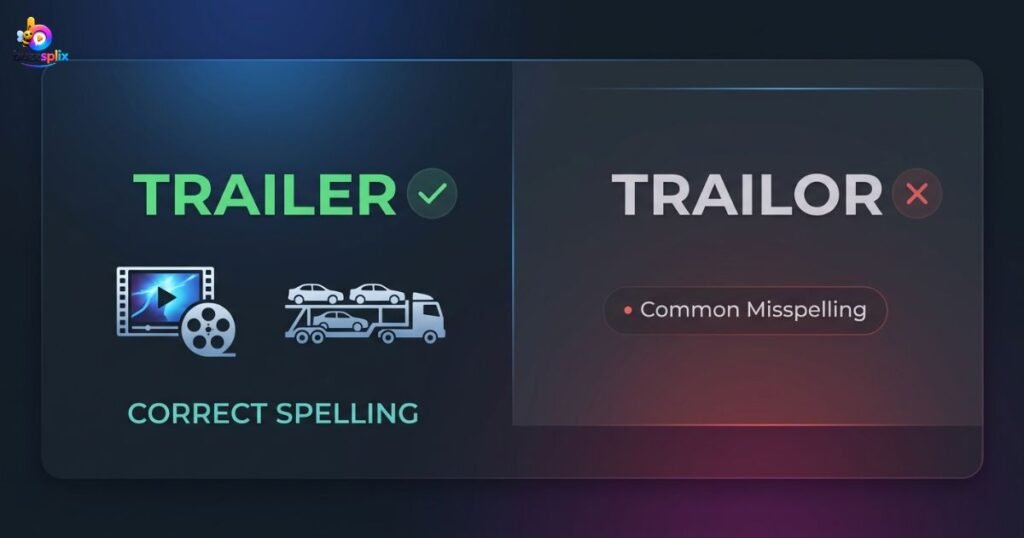
| Trailer | Trailor | |
| Correct spelling? | Yes | No |
| Found in dictionaries? | Yes | No |
| Common usage | Vehicles, movie previews, someone/something that trails | None (misspelling) |
| Safe to use in writing? | Yes | Never |
If you remember nothing else from this article, remember this table. There’s no context, industry, or region where “trailor” becomes the correct choice.
What Does “Trailer” Actually Mean?
Trailer is a noun with a few related meanings, all connected to the idea of something that follows, drags, or gets pulled along.
- A vehicle towed by another vehicle — used for hauling cargo, boats, livestock, or as a mobile home.
- A short preview of a movie or TV show — released to build interest before the full release.
- Something or someone that trails behind — a plant that trails along the ground, or a person following another.
- A mobile or manufactured home — commonly used in casual speech, especially in the term “trailer park.”
The word comes from the verb trail, meaning to drag or follow behind, plus the suffix -er, which turns a verb into a noun describing a person or thing that performs that action. A trailer, quite literally, is something that trails.
Is “Trailor” Ever Acceptable?
No. Trailor is not listed in Merriam-Webster, Oxford, Cambridge, or any other major English dictionary. It’s not a regional variant, a British-versus-American spelling difference, or an older historical form that fell out of use. It’s simply a spelling error.
You might spot “trailor” used as a surname or in a business name, since names don’t have to follow standard spelling rules. But outside of proper nouns, treat it as incorrect every single time.
The Real Rule Behind “-er” vs “-or”
There’s no single foolproof rule that predicts every English word, but there’s a pattern that helps most of the time.
- Words built from verbs of Old English or Germanic origin usually take -er (teacher, worker, trailer, singer).
- Words borrowed from Latin, especially ones tied to formal roles or professions, often take -or (doctor, actor, director, inspector).
Since trail is a native English verb, its noun form naturally takes the Germanic -er ending rather than the Latin-style -or. This same logic explains why we write player, runner, and helper, not “playor,” “runnor,” or “helpor.”
3 Simple Ways to Never Misspell “Trailer” Again
1. Say it, don’t guess it. Sound out “trail” plus “er.” If you can hear the base word trail inside it, the ending is almost always -er.
2. Compare it to a word you already know. Think of sailor versus tailor versus trailer. Yes, English is inconsistent, but pairing the tricky word with a familiar one (like remembering “trailer rhymes with mailer”) locks it into memory faster than a grammar rule ever will.
3. Type it, then check it twice. Autocorrect doesn’t always catch “trailor” because it’s close enough to real words that some tools let it slide. A quick manual glance before hitting send saves you from an easily avoidable error.
Common Words People Misspell the Same Way
If “trailer” trips you up, these words probably do too. They all follow the same -er pattern that gets confused with -or:
| Correct | Common Misspelling |
| Trailer | Trailor |
| Mailer | Mailor |
| Sailor* | Sailer |
| Retailer | Retailor |
| Container | Containor |
*Note: sailor is actually the exception here, it’s one of the few common -or words tied to a native English verb (sail), which shows why memorizing a handful of tricky exceptions works better than relying on one strict rule.
Real Examples of “Trailer” in Everyday Use
Seeing the word in context makes it easier to remember and use correctly.
- “We hitched the trailer to the truck before the road trip.”
- “The movie’s trailer dropped online this morning and already has a million views.”
- “She lives in a trailer just outside of town.”
- “The dog’s leash trailed behind him like a small trailer of its own.”
- “Our company just leased a new equipment trailer for the job site.”
Notice that in every sentence, “trailer” fits naturally as a noun, whether it’s describing a physical object or a video preview. There’s no version of these sentences where “trailor” would work instead.
How Autocorrect and Spell Checkers Handle This Mistake
Most modern spell checkers will flag “trailor” as incorrect and suggest “trailer” or “tailor” instead. But not every platform catches it, especially casual texting apps, social media captions, or older software. If you’re writing something public-facing, like a business listing, resume, or article, don’t rely on autocorrect alone. A quick manual proofread catches mistakes that software sometimes misses.
Mini Quiz: Test Yourself
Try filling in the blank before checking the answer.
- “We rented a horse ______ for the weekend.” (trailer/trailor)
- “Have you seen the new ______ for that superhero movie?” (trailer/trailor)
- “My neighbor just bought a travel ______.” (trailer/trailor)
Answer: All three should be spelled trailer. If you got them right, you’ve already got the rule down.
Pro Tip: A Simple Habit That Prevents Most Spelling Mistakes
Beyond just this word, one habit fixes a huge chunk of everyday spelling errors: reading your sentence out loud before you finalize it. Your ear often catches what your eye skips over, especially with words that sound nearly identical to a misspelled version.
Pair that with keeping a short personal list of words you regularly mix up, and your accuracy improves fast without needing to memorize formal grammar rules.
Frequently Asked Questions
Is it trailer or trailor?
It’s trailer. This is the only correct spelling in standard English, whether you’re talking about a towed vehicle, a movie preview, or something that trails behind.
Is trailor ever correct?
No, except as a proper noun like a surname or business name. In all standard usage, “trailor” is a misspelling of trailer.
Why do people spell trailer wrong?
The mix-up usually happens because English has many similar-sounding words that end in -or, like actor or doctor.
What does trailer mean?
Trailer can refer to a vehicle towed behind another vehicle, a short preview clip for a movie or show, a mobile home, or generally something that trails or follows behind.
How can I remember the correct spelling of trailer?
Break it down into “trail” plus “er,” and say it out loud. If you can hear the word trail clearly inside it, you’ll remember the ending is -er, not -or.
Final Thoughts
The spelling debate between trailer and trailor isn’t really a debate at all. Trailer is correct, trailor isn’t a recognized word, and once you connect it back to the verb “trail,” the spelling becomes easy to remember for good.
Small mistakes like this one are common, but they’re also simple to fix once you know the pattern behind them. The next time you’re writing about a truck, a movie, or a mobile home, you can type “trailer” with full confidence.