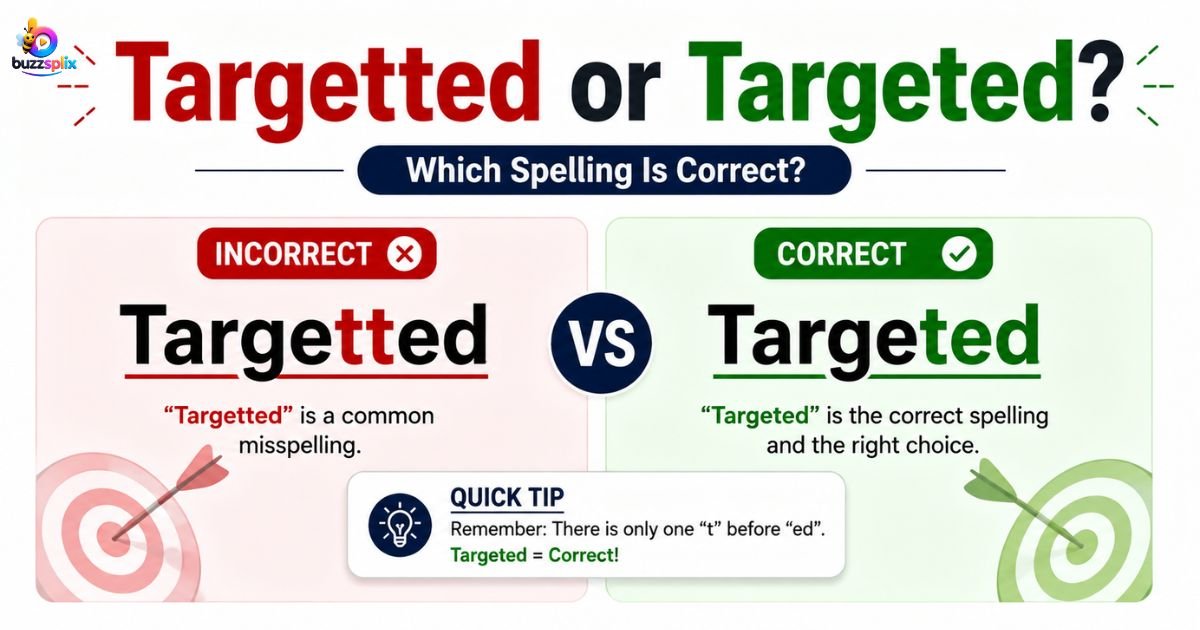
You typed it, stared at it, and now something feels off. Is it targetted or targeted? You’re not alone. This one word trips up writers, marketers, and students constantly, and spellcheck doesn’t always catch it fast enough to stop the doubt.
The good news is the answer is simple once you know the rule, and it applies whether you’re writing an email, an essay, or an ad campaign.
Quick Answer
Targeted is the correct spelling in both American and British English. Targetted, with two T’s, is a common misspelling and is not recognized by any major dictionary. If you’re aiming for, focusing on, or directing something at a specific group or goal, targeted is the word you want.
Targetted vs Targeted at a Glance
| Targeted | Targetted | |
| Correct spelling | Yes | No |
| Found in dictionaries | Yes (Merriam-Webster, Oxford, Cambridge) | No |
| Used in American English | Yes | Never correct |
| Used in British English | Yes | Never correct |
| Common in casual writing | Yes | Sometimes, by mistake |
Why Is “Targeted” Spelled With One T?
English spelling rules for adding -ed to a verb depend on where the stress falls in the word. Here’s the short version: when a word ends in a single consonant after a single vowel, you double that consonant before adding a suffix, but only if the stress lands on the final syllable.
Take the word target. It’s pronounced TAR-get, with the stress on the first syllable, not the second. Because the stress falls on “tar” and not “get,” the final consonant does not get doubled. That gives you target + ed = targeted.
Compare that to a word like permit, pronounced per-MIT, where the stress lands on the second syllable. That’s why you get permitted with two T’s. The rule isn’t random. It follows a consistent pattern in English spelling, even if it doesn’t always feel intuitive.
Why Do People Write “Targetted”?
The mix-up usually comes from pattern matching. Words like permitted, regretted, and committed all double their final consonant, and writers assume target should follow the same path. It’s an understandable guess, but it’s the wrong one because those words are stressed differently.
Autocorrect and predictive text can also plant the wrong version in someone’s memory if they’ve seen it typed incorrectly enough times online. Once a misspelling becomes visually familiar, it’s easy to second-guess the correct form.
Targeting vs Targetting: Which Is Correct?
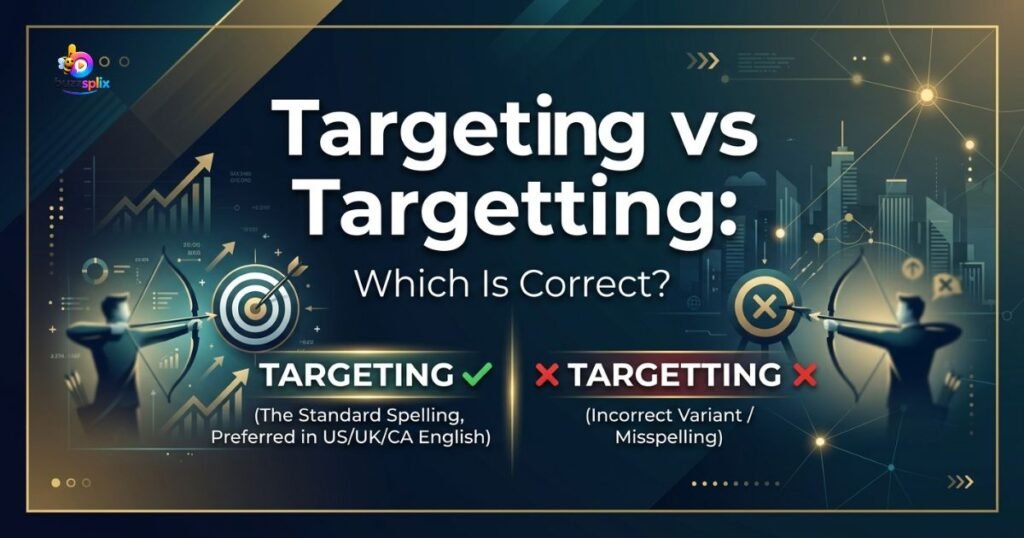
The same rule applies here. Since the stress in target sits on the first syllable, the correct spelling is targeting, with one T. Targetting is incorrect in every form of English, spoken or written, formal or casual.
Is “Targetted” Ever Correct in British English?
No. This is a common assumption because British and American English do differ on some doubled-consonant words, like travelled versus traveled or cancelled versus canceled. But that difference only shows up in words where the stress pattern allows for it, or where British convention doubles the consonant regardless of stress, as with travel.
Target doesn’t fall into that category. Since the stress lands on the first syllable, both American and British English keep the single T. Targeted is standard on both sides of the Atlantic, and no major style guide treats targetted as an acceptable regional variant.
How the Suffix Rule Works With Other Words
Understanding the pattern behind targeted makes it easier to spell similar words correctly without memorizing each one individually. Here’s the underlying logic:
- Stress on the last syllable + single vowel + single consonant → double the consonant (refer → referred)
- Stress on an earlier syllable → do not double the consonant (target → targeted, market → marketed, visit → visited)
Once you can hear where the stress falls, the spelling usually follows.
Examples of “Targeted” in Sentences
Business Examples
- The marketing team launched a targeted ad campaign for first-time buyers.
- Our outreach strategy is more effective when it’s targeted at the right audience.
- The company targeted small businesses with its new pricing plan.
Academic Examples
- The study used a targeted sample of participants aged 18 to 25.
- Researchers targeted specific genes to understand the disease’s progression.
- Her thesis proposed a targeted intervention for early literacy struggles.
Everyday Examples
- He felt like the criticism was personally targeted at him.
- The app sends targeted notifications based on your location.
- Their fundraising letter was clearly targeted toward past donors.
Common Mistakes to Avoid
Beyond the double-T error, a few related mix-ups show up often:
- Writing targetting instead of targeting in present-tense sentences.
- Confusing targeted with targetted when spellchecking manually, since the extra T can look plausible at a glance.
- Assuming British English always doubles consonants before -ed. It depends on the word’s stress and standard convention, not a blanket rule.
If you’re ever unsure, say the word out loud and listen for the stress. TAR-get keeps its single T no matter what tense or form you’re using.
Common Words Similar to Targeted
Several everyday words follow the same single-consonant pattern because their stress also falls on the first syllable:
- Market → marketed, marketing
- Visit → visited, visiting
- Benefit → benefited, benefiting
- Offer → offered, offering
- Focus → focused, focusing
Seeing these side by side makes the pattern easier to remember than trying to memorize target in isolation.
How to Remember the Correct Spelling
A simple trick: think of the phrase “one target, one T.” Since target already starts with a single T, keeping the spelling consistent when you add -ed or -ing means sticking with just one. If you picture a single arrow hitting a single target, the visual can help the spelling stick.
Another method is to compare it to a word you already spell correctly without hesitation, like market. If you wouldn’t write markettted, there’s no reason to double the T in targetted either. Both words share the same stress pattern and follow the same rule.
Frequently Asked Questions
Is targetted a real word?
No. Targetted is a misspelling and does not appear in Merriam-Webster, Oxford, or Cambridge dictionaries. The correct spelling in all contexts is targeted, with one T.
Why is targeted spelled with one T?
Because the stress in target falls on the first syllable, not the last. English spelling rules only double the final consonant before adding -ed when the stress lands on that final syllable, which doesn’t happen with target.
Is targetted accepted anywhere?
No major style guide, publisher, or dictionary in American or British English recognizes targetted as a correct or accepted variant. It’s considered a spelling error wherever it appears.
How do you spell targeting?
Targeting, with one T, is correct. The same stress-based rule that applies to targeted applies here, since the emphasis stays on the first syllable of target.
What is the meaning of targeted?
Targeted means aimed at, focused on, or directed toward a specific person, group, or goal. It’s commonly used in marketing, research, healthcare, and everyday conversation to describe something with a clear, intentional focus.
Conclusion
The rule behind targeted comes down to one thing: where the stress falls in the original word. Since target is stressed on its first syllable, it keeps a single T when you add -ed or -ing, no matter which English variant you’re writing in.
Targetted simply isn’t correct, and once you connect the spelling to the pronunciation, it’s a rule you won’t need to second-guess again.