You just read a line like “deafening silence” and something in your brain paused. Is that a mistake? A clever trick? Then two sentences later, a writer places a wedding scene right next to a funeral scene, and you feel the same kind of jolt.
The problem is you’re not sure which literary device you’re looking at. Oxymoron vs juxtaposition confuses even careful readers because both devices thrive on contrast, but they don’t work the same way, and mixing them up can throw off how you analyze or write a piece entirely.
Quick Answer: Oxymoron vs Juxtaposition
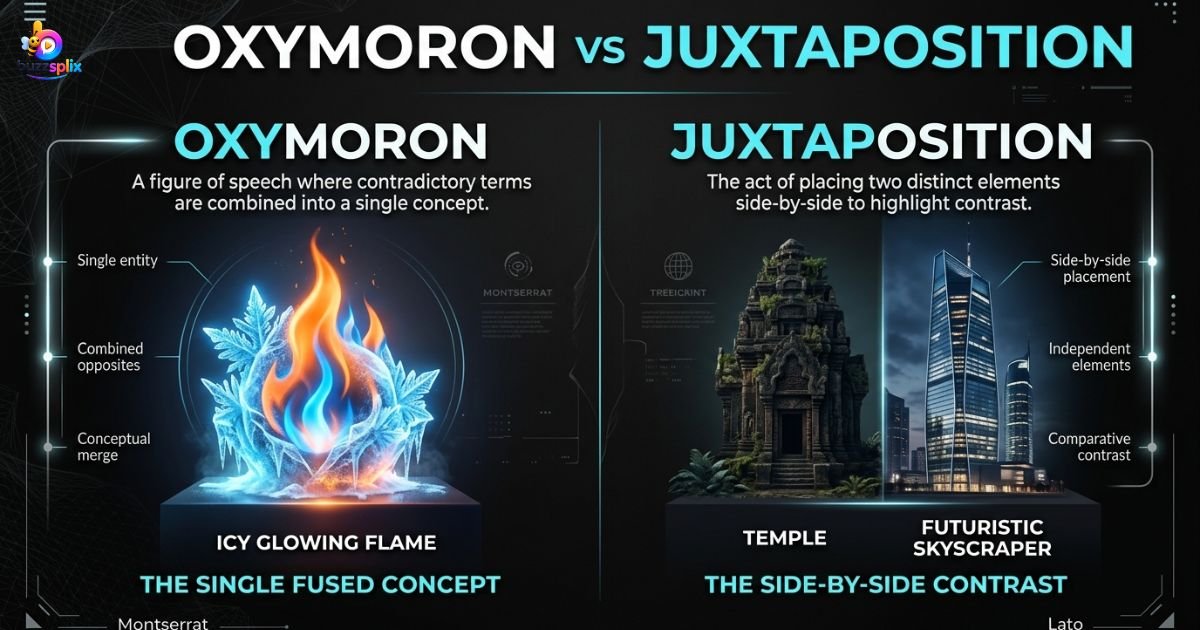
An oxymoron pairs two contradictory words right next to each other, like “bittersweet” or “organized chaos,” to create a compact, self-contained contradiction.
Juxtaposition is broader: it places two contrasting ideas, characters, images, or scenes near each other in a text so the reader notices the difference between them.
In short, an oxymoron is a tiny phrase-level contradiction, while juxtaposition is a structural technique that can stretch across a sentence, a scene, or an entire story.
What Is an Oxymoron?
An oxymoron is a figure of speech that combines two words with opposite or conflicting meanings into a single phrase. The contradiction is intentional. It’s meant to surprise the reader for a moment and then reveal a deeper truth or a sharper image than either word could create alone.
The word itself comes from Greek roots meaning “sharp” and “dull,” which is fitting since an oxymoron is basically a smart contradiction packed into two or three words.
Common examples of oxymorons:
- Deafening silence
- Jumbo shrimp
- Living dead
- Act naturally
- Only choice
- Seriously funny
- Open secret
Oxymorons show up constantly in everyday speech, not just in poetry or fiction. When someone says they’re in “a love-hate relationship,” that’s an oxymoron doing real communicative work, not just a stylistic flourish.
What Is Juxtaposition?
Juxtaposition happens when a writer places two things side by side so their differences (or sometimes their surprising similarities) become obvious. Those two things can be characters, settings, ideas, images, tones, or even entire storylines. Unlike an oxymoron, juxtaposition doesn’t need contradictory words crammed into one phrase. It works at the level of structure and meaning.
Example sentence: “The children laughed on the swings while, just beyond the fence, soldiers marched past in silence.”
Here, nothing in that sentence is a contradiction in itself. Each half makes complete sense on its own. But putting them together creates a contrast that says something the individual sentences couldn’t say alone, in this case, something about innocence sitting uncomfortably close to conflict.
Oxymoron vs Juxtaposition Comparison Table
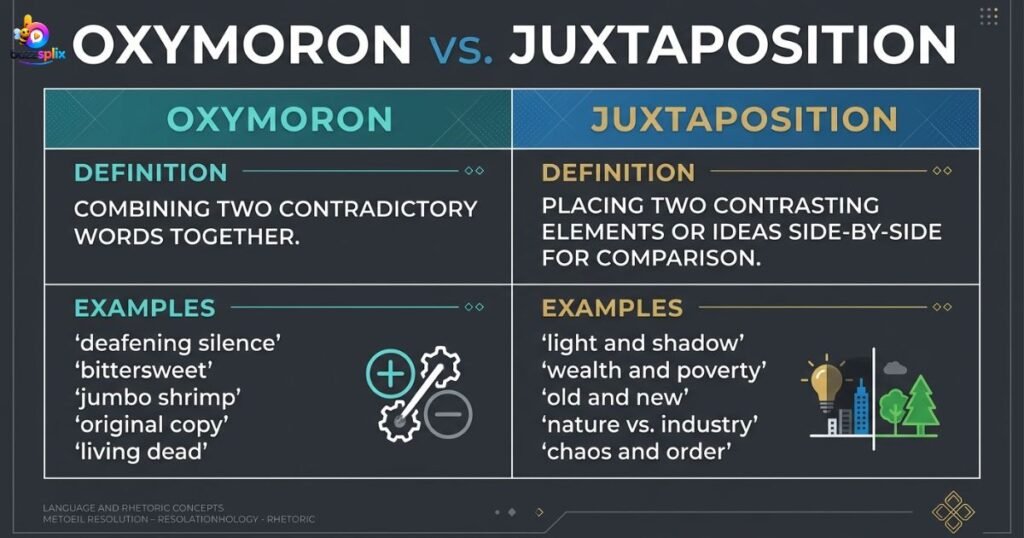
| Feature | Oxymoron | Juxtaposition |
| Definition | Two contradictory words combined in one phrase | Two contrasting ideas placed near each other |
| Scale | Word or short phrase | Sentence, scene, or entire work |
| Contradiction required? | Yes, always | No, contrast can exist without contradiction |
| Example | “Bittersweet ending” | A rich character and a poor character shown side by side |
| Primary effect | Compresses meaning, adds wit or irony | Highlights differences, builds theme or tension |
| Where it appears | Common in idioms, headlines, poetry | Common in fiction, film, art, argument, and rhetoric |
Key Differences Between Oxymoron and Juxtaposition
The clearest way to separate these two devices is to look at scope and contradiction.
Scope. An oxymoron lives inside a tight, self-contained phrase. Juxtaposition can span a much bigger stretch of text, from a single line to an entire book structured around two opposing plots.
Contradiction. An oxymoron always involves a logical contradiction between its two words. Juxtaposition just requires contrast or difference, which doesn’t have to be a contradiction at all. Placing a tall building next to a small cottage is juxtaposition, but there’s nothing contradictory about it.
Relationship between the two. Every oxymoron is technically a tiny example of juxtaposition, since it places contrasting words side by side. But not every juxtaposition is an oxymoron, because most juxtapositions don’t involve direct verbal contradiction. Think of oxymoron as a specific, compressed tool, and juxtaposition as the wider category it belongs to.
How to Identify an Oxymoron in a Sentence
If you’re trying to spot an oxymoron quickly, ask yourself one question: do these two words cancel each other out logically?
If “jumbo” means big and “shrimp” implies small, and both words sit right next to each other describing the same thing, you’ve found an oxymoron. The test is simple: isolate the two key words and check whether they directly contradict.
A quick trick: oxymorons are almost always two or three words long. If the contrast you’re noticing spans a full sentence or more, you’re probably looking at juxtaposition instead.
How to Identify Juxtaposition in a Text
Juxtaposition is a little harder to spot because it doesn’t announce itself with contradictory words. Instead, look for:
- Two scenes or images placed back-to-back for contrast
- A shift in tone, mood, or pace between two sections
- Characters with opposite traits appearing in the same scene
- Descriptions that highlight difference without stating it outright
If you notice the writer isn’t explaining the contrast directly but is letting you feel it by placing things next to each other, that’s juxtaposition at work.
Real-World Examples in Literature and Film
Writers rely on both devices constantly, often in the same piece of work.
Oxymoron in literature: Shakespeare used oxymorons often to capture emotional confusion, such as Romeo describing love as “heavy lightness” and “cold fire” in Romeo and Juliet. These phrases mirror the character’s conflicted feelings in a compact way.
Juxtaposition in literature: Charles Dickens opens A Tale of Two Cities by placing opposite ideas side by side, describing an era that felt like both the best and worst of times. That structure sets up the entire contrast the novel explores between two cities and two very different worlds.
Juxtaposition in film: Directors often cut between a peaceful scene and a violent one to heighten emotional impact. The contrast does the storytelling work without a single line of dialogue explaining it.
Why Writers Use Oxymorons
Oxymorons let writers say more with less. A single phrase like “controlled chaos” captures a complicated idea (something that feels wild but is actually managed) faster than a full sentence could. They’re also useful for:
- Adding wit or irony to a line
- Creating memorable headlines or titles
- Expressing complex emotional states in a short phrase
- Making dialogue sound natural, since people use oxymorons in casual speech all the time
Why Writers Use Juxtaposition
Juxtaposition helps writers make an argument or build a theme without stating it directly. Instead of telling the reader “wealth and poverty exist side by side in this city,” a writer can simply show a mansion on one street and a shelter on the next. The reader draws the conclusion themselves, which tends to feel more persuasive and more memorable than a direct statement.
It’s also a strong tool for:
- Building tension between characters or ideas
- Emphasizing a theme through contrast rather than explanation
- Creating irony by placing mismatched elements together
- Pacing a story, since alternating between contrasting scenes keeps readers engaged
Common Mistakes People Make With These Terms
A few mix-ups come up again and again.
Mistake 1: Calling every contrast an oxymoron. If someone says “she was strong yet gentle” across a full sentence, that’s juxtaposition, not an oxymoron. There’s no single contradictory phrase there.
Mistake 2: Assuming oxymorons must be famous or poetic. Everyday phrases like “small crowd” or “same difference” count as oxymorons even though they show up in casual conversation, not just literature.
Mistake 3: Confusing juxtaposition with simple comparison. A comparison usually points out similarity (“she’s as brave as her father”). Juxtaposition points out contrast by placing two different things next to each other, not by comparing their similarities.
Mistake 4: Thinking juxtaposition always needs opposite meanings. It doesn’t. Juxtaposition can highlight subtle differences too, not just extreme opposites.
Oxymoron vs Juxtaposition: A Simple Way to Remember It
Here’s a shortcut that tends to stick: an oxymoron is a contradiction you can hold in one hand, just two or three words. Juxtaposition is a contrast you need both hands for, since it usually involves comparing two larger elements, like scenes, characters, or ideas, that sit near each other in the text.
If you can point to a single phrase and say “these two words fight each other,” you’ve got an oxymoron. If you need to point to two separate parts of a sentence, scene, or story and say “look how different these are,” you’re looking at juxtaposition.
Frequently Asked Questions
Is an oxymoron a type of juxtaposition?
Yes, in a narrow sense. An oxymoron juxtaposes two contradictory words within a single phrase, so it can be considered a compressed, word-level form of juxtaposition. \
What is the easiest way to identify an oxymoron?
Check whether two words placed together directly contradict each other’s meaning, like “clearly confused.” If the contradiction fits inside a short phrase rather than a full sentence or scene, it’s an oxymoron.
Why do writers use juxtaposition?
Writers use juxtaposition to build contrast, tension, or theme without explaining it outright.
Is “pretty ugly” an oxymoron?
Yes. “Pretty” and “ugly” pull in opposite directions when paired together, which fits the definition of an oxymoron.
Can a sentence contain both an oxymoron and juxtaposition?
Yes, and this happens more often than people expect. A sentence might use an oxymoron like “bitter joy” while also juxtaposing two separate images or characters elsewhere in the same passage.
Conclusion
Oxymoron and juxtaposition both rely on contrast, but they operate at different scales and with different rules. An oxymoron packs a contradiction into a tight phrase, while juxtaposition spreads contrast across a wider stretch of text to let the reader feel the difference themselves.
Once you know what to look for, spotting either device becomes second nature, and your own writing gets sharper for it too.