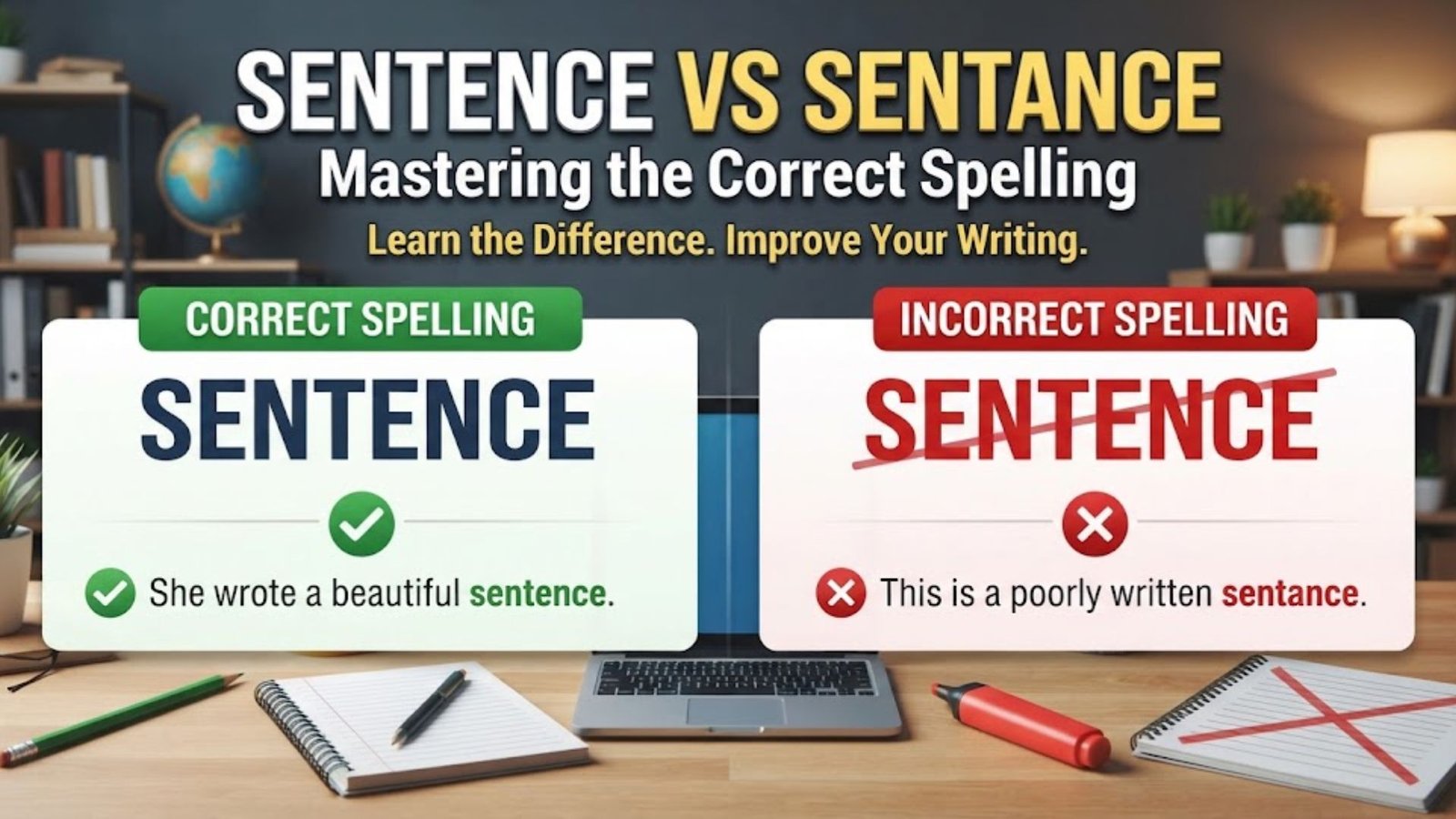
Ever typed a word so fast you second guessed it right after hitting send? That’s exactly what happens with sentence and sentance. You write it, you stare at it, and suddenly it looks wrong even when it’s right.This mix up shows up everywhere. Students write it in essays. Professionals type it in emails.
Even native English speakers pause and wonder which version is real.So let’s settle this once and for all.
Quick Answer
Sentence is the correct spelling. Sentance is not a recognized word in any standard dictionary, including Merriam-Webster.
This isn’t a case of British English versus American English. Both regions agree on this one. There’s no regional split, no debate, no gray area.
The confusion mostly comes from how the word sounds when spoken quickly. Your ear hears “sentance,” but your writing needs “sentence.”
Examples
Here’s how the correct spelling looks in real use:
- She wrote a beautiful sentence to open her essay.
- The judge read out the sentence in court.
- Can you fix this sentence? It feels incomplete.
- His sentence structure improved after months of practice.
Notice something? Every one of these uses sentence, not the incorrect form. That’s your baseline going forward.
The Origin of Sentence or Sentance
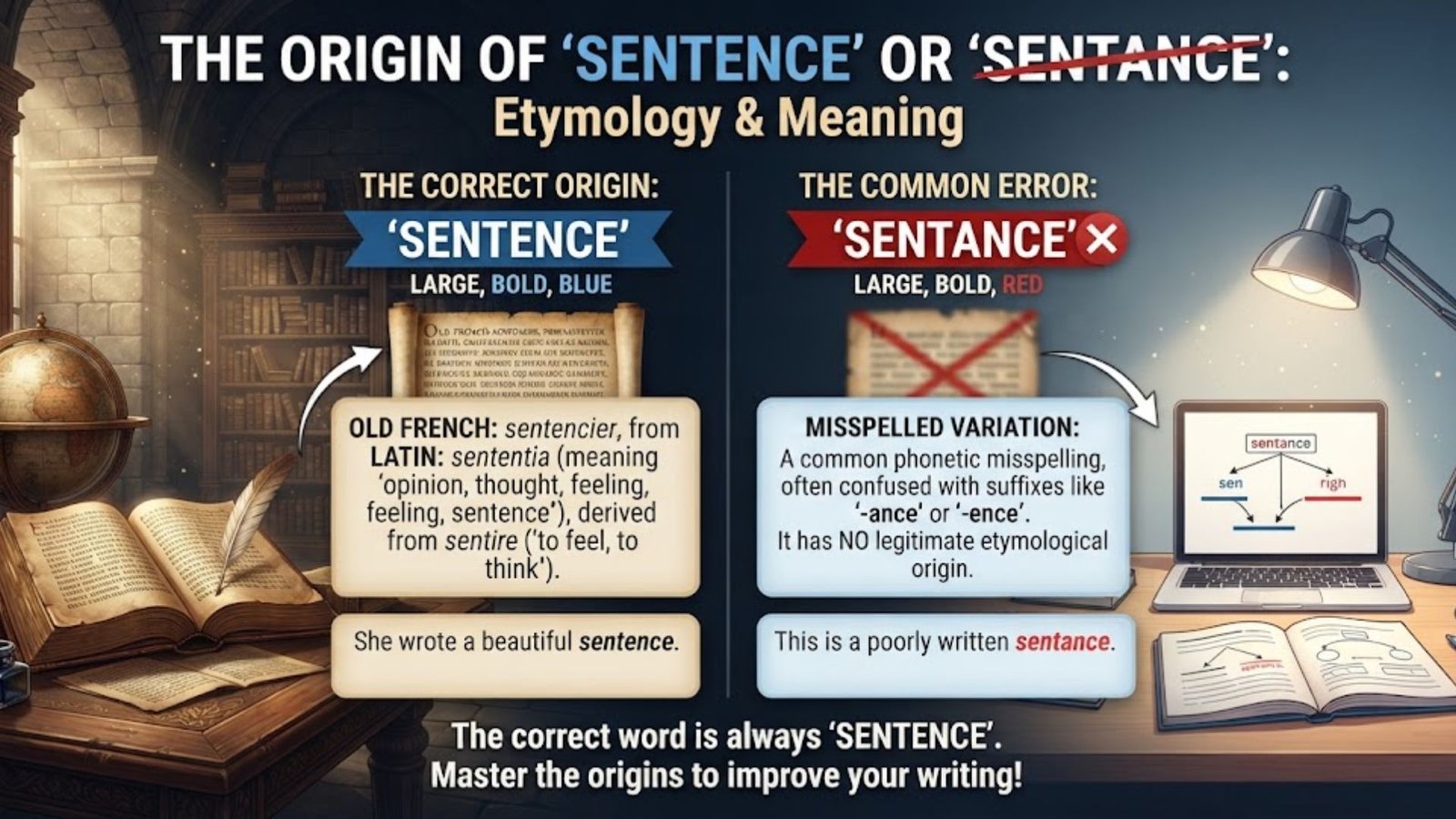
Words don’t just appear out of nowhere. They travel through centuries, picking up new spellings and meanings along the way. Sentence has quite a journey behind it.
The word traces back to the Latin term sententia, which meant thought, opinion, or judgment. That root explains a lot. Even today, a legal sentence reflects a judge’s judgment, and a written sentence expresses a complete thought.
From Latin, the word moved into Old French, then made its way into Middle English. Each stage kept the “ence” ending intact. That’s not an accident. It’s part of the word’s etymological origin, and it’s exactly why sentance never had a real place in the language.
British English vs American English Spelling
People often assume spelling differences explain every English mix up. Think colour vs color. That’s a fair guess, but it doesn’t apply here.
British English and American English disagree on plenty of words. But sentence isn’t one of them. Both sides of the Atlantic spell it the exact same way.
This matters because a lot of learners assume regional spelling is behind every confusing word pair. Here, though, the issue isn’t regional variation. It’s simply a common misspelling driven by pronunciation, not geography.
So whether you’re writing for a UK audience or a US one, you’re safe using sentence across the board.
Which Spelling Should You Use?
This one’s easy. Always use sentence. There’s no formal writing style, academic guide, or grammar rule anywhere that accepts sentance as valid.
If you’re a student working on an essay, a professional drafting a report, or just someone texting a friend, stick with sentence. It’s the only form that shows up in major dictionaries, style guides, and grammar checkers.
Autocorrect tools will flag sentance almost instantly. That’s not the tool being picky. It’s confirming what every standard dictionary already knows. Sentence is the correct form, full stop.
Common Mistakes with Sentence
Spelling errors rarely happen in isolation. They usually come bundled with a few related slip ups. Let’s break down the most common ones.
1. Using Sentance
This is the most frequent mistake by far. It happens because the word sounds like it should end in “ance,” similar to words like “distance” or “guidance.” But sentence doesn’t follow that pattern.
This is a classic phonetic error. Your brain hears the sound and guesses the spelling based on similar sounding words. Unfortunately, English doesn’t always play fair with logic like that.
2. Confusing with Similar Words
Some writers mix up sentence with words like “sentenced” or “sentences” and lose track of which form fits the context. Others confuse it with unrelated words that just sound close enough to cause hesitation while typing.
A quick trick helps here. Break the word down as sense plus ence. If you can spell “sense,” you can spell sentence correctly every time.
3. Ignoring Grammar Context
Sometimes the spelling is fine, but the grammar around it isn’t. People forget that a proper sentence needs both a subject and a predicate to count as a complete thought.
Skip either one, and you end up with sentence fragments instead of full sentences. That’s a different problem, but it often shows up right alongside spelling confusion.
Sentence or Sentance in Everyday Examples
Context changes everything when it comes to writing. Let’s look at how this word shows up across different settings, and why getting it right matters more in some places than others.
Academic Writing
In essays and research papers, spelling accuracy carries real weight. Teachers and professors notice repeated errors, and they often connect sloppy spelling to sloppy thinking.
Students preparing for exams should treat this word as non negotiable. One wrong sentence spelling might seem small, but it chips away at overall writing accuracy and leaves a weaker impression on the reader.
Emails
Professional emails are judged fast. Readers skim, and errors jump out immediately. Using sentance instead of sentence in a work email can quietly damage your professional credibility.
Think about it from the reader’s side. A clean, correctly spelled email signals confidence. A messy one raises doubt, even if the actual message is solid.
Social Media
Social media posts are more relaxed, sure. Nobody expects perfect grammar in a quick tweet or caption. Still, misspelling common words repeatedly can affect how seriously people take your content.
If you’re building a brand or a following, small errors add up. Readers might not call it out, but they notice.
Legal Writing
This is where the word carries extra weight. A legal sentence refers to the judgment a court hands down, like “five years in prison.” Judges issue a sentence, and the verb to sentence someone appears constantly in legal documents.
Given how formal and precise legal writing needs to be, there’s zero room for the incorrect spelling here. Courts, lawyers, and legal students must get this exactly right every single time.
Textbooks
Textbooks and grammar guides rely on this word constantly to explain sentence structure, clauses, and basic writing rules. Since these materials shape how students learn, accuracy isn’t optional.
If a textbook got this wrong, it would confuse an entire generation of English learners. That’s exactly why publishers double and triple check spelling before printing.
Google Trends & Usage Data
Curious how often people actually search for this? Google Trends shows a steady stream of spelling searches for terms like “is sentance a word” and “sentence or sentance.”
This tells us something important. Search volume around this topic isn’t random. It reflects genuine, widespread confusion among language learners, students, and even experienced writers who just want to double check themselves.
Grammar searches like these tend to spike around exam seasons and back to school periods, which makes sense. New writers are more likely to second guess basic word usage while they’re still building confidence.
Comparison Table
| Aspect | Sentence | Sentance |
| Correct Spelling | Yes | No |
| Dictionary Recognition | Found in all major dictionaries | Not found anywhere |
| Word Origin | Latin sententia, via Old French and Middle English | No real etymology |
| British English | Standard usage | Never used |
| American English | Standard usage | Never used |
| Common Cause | N/A | Phonetic error and autocorrect confusion |
How to Remember Sentence Spelling for Good
Here’s a sentence memory trick that actually works. Picture the word as two smaller pieces stitched together: “sense” plus “ence.” If you know how to spell “sense,” you already know most of the word.
Another trick? Think about the ending. Words like “essence,” “presence,” and “sentence” all share that “ence” pattern. Group them together in your head, and the correct spelling starts to feel automatic.
Repetition helps too. Write the word a few extra times in your notes or practice sentences. Spelling learning works best through small, consistent reinforcement rather than one big memorization session.
Related Word Pairs That Confuse Writers
Sentence isn’t the only word that trips people up. English is full of these traps, and once you notice the pattern, spotting them gets easier.
- Labeller or Labeler: another UK vs US spelling situation, though this one actually does split by region.
- Loose or Lose: a classic mix up based purely on sound, not meaning.
- Laying or Lying: confusing verb forms that even confident writers slip on.
Learning these pairs together builds stronger overall writing skills and sharpens your instinct for correct usage across the board.
Why Spelling Accuracy Still Matters in 2026
You might think spell checkers have made this a non issue. They haven’t, not entirely. Autocorrect catches obvious errors, but it can’t fix everything, especially in fast typed messages or documents where suggestions get ignored.
Clarity and credibility still depend on the writer, not the software. A single misspelled word won’t ruin your reputation, but a pattern of them will.
Good writing builds trust. Readers associate error free writing with careful thinking, and that association isn’t going away anytime soon.
FAQs
Is sentance a word? No. It has no listing in any standard dictionary and holds no accepted meaning in English.
Why is sentence spelled with ence? Because it comes from the Latin word sententia, and that spelling pattern survived through Old French and Middle English into modern usage.
Can I use sentance in casual writing? No. Even in informal writing or texting, sentance is still considered a spelling mistake, not an accepted variant.
What’s the plural of sentence? Sentences. Simple addition of an “s,” no irregular twist involved.
What’s the verb form of sentence? To sentence someone, as in a legal judgment. Past tense becomes sentenced, commonly used in courtroom and news reporting contexts.
Does British English spell it differently than American English? No. This is one of the rare words where UK spelling and US spelling match exactly, with zero regional differences.
Conclusion
At the end of the day, this comparison isn’t close. Sentence is correct. Sentance simply isn’t a real word, no matter how natural it might sound when you say it out loud.Understanding the word origin, recognizing the common misspelling, and using a few memory tricks can help you avoid this error for good. Whether you’re writing an email, an essay, or a legal document, getting this right adds a small but real layer of professionalism to your work.
Got another confusing word pair you want cleared up? Drop it in the comments, and let’s sort it out together.