
You’re typing a welcome email, your fingers pause, and suddenly the word looks wrong. Is it visiter or visitor? Visitor is the correct spelling. Visiter is a common misspelling with an extra “e” that no English word list accepts.
That’s the whole answer in 30 seconds. Stick around if you want to know why the mix-up happens and how to stop it for good.
Visiter
Visiter is the incorrect spelling. You won’t find it in dictionaries or style guides as a valid English word.
So why does it show up so often? Many writers hear a soft “er” sound at the end and type what they hear. That’s a spelling mistake, not a regional choice.
Visitor
Visitor is the standard spelling and the correct form. It’s a noun that names a person who goes to see a place or another person.
The ending is -or, not -er. Once you lock that in, the word stops being tricky.
Visiter or Visitor: Quick Answer
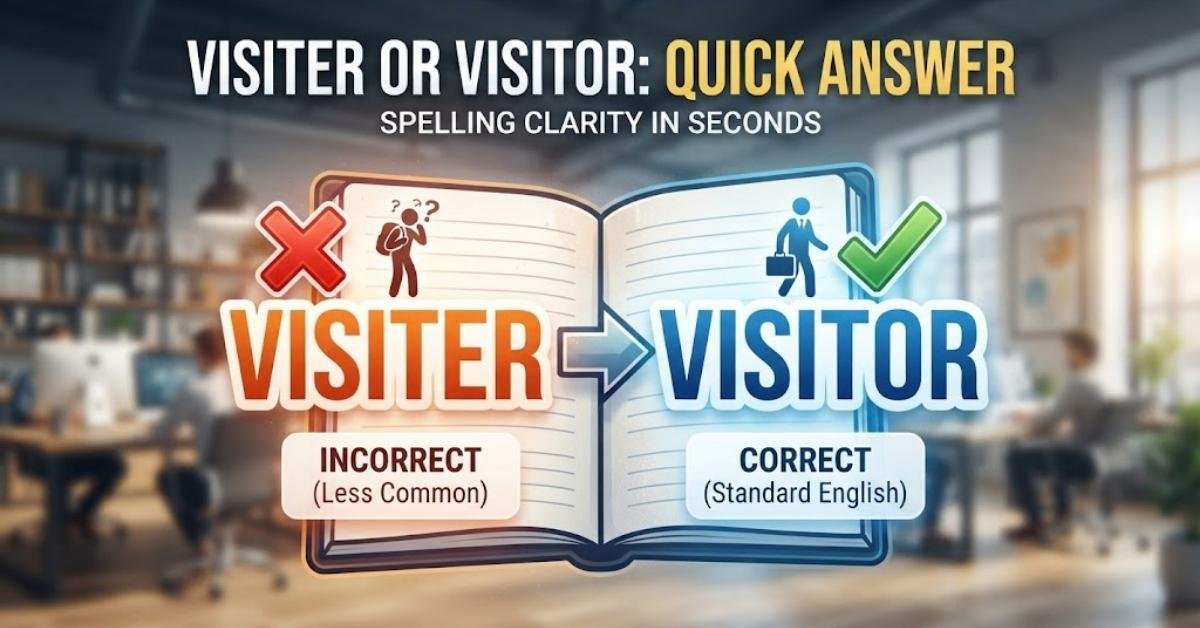
Use visitor. That applies to business emails, schoolwork, social media posts, and every other place you’d write it.
Here’s a fast check. If the word means a person who visits, it ends in -or. If you’re writing visiter, you’ve added a letter the word never asked for.
The plural of visitor is visitors. Nothing changes except the final “s.”
The Origin of Visitor

The word origin explains the ending. Visitor traces back to the Latin origin visitare, which means “to go to see” or “to pay a visit.” That’s the same root behind the verb visit.
From Latin, the word passed into Old French as visiteur. Later it landed in Middle English, where it settled into the -or ending we use today.
That path is the reason for the -or suffix. Many Latin agent words, meaning names for someone who does something, kept -or when English borrowed them. Think actor and director. The historical development of English then locked in this standardized spelling.
British English vs American English Spelling

Good news: there’s no split here. British English and American English both spell it visitor. Whether you write for UK audiences, US audiences, or Commonwealth audiences, the word stays the same.
Compare that with pairs like color and colour. Those trip people up because regional spelling differs. Visitor is a universal standard, so you can skip the regional checklist.
That makes it easy for global writing and international English. One spelling covers US English, UK English, and every English-speaking country in between.
Which Spelling Should You Use?
Always use visitor. It’s the only correct word for a person who visits, and readers spot the wrong version fast.
Picture the front desk at a small hotel. A guest scrolls the check-in sign and sees “Visiter Registration.” Nobody panics, but the sign quietly says nobody proofread it.
That’s the real cost. In professional writing, one small spelling error can chip away at credibility. Writers who care about clarity and professionalism get the small stuff right.
Common Mistakes with Visiter or Visitor
The biggest slip is adding an extra “e” and writing visiter. The plural goes wrong the same way, giving you visiters. Some writers also drop letters and produce vister or visetor.
Other mistakes are about usage, not spelling. Some people treat visitor as a verb, which doesn’t work. The verb is visit, and the visitor noun is the person doing it.
Here are the common typos to watch for:
- Visiter and visiters (extra “e”)
- Vister and visetor (missing or swapped letters)
- Visitor used where you need visit (incorrect verb usage)
- Visitor used when you mean tourist or guest
- Forgetting the “s” in visitors when you mean more than one person
Visiter or Visitor in Everyday Examples
Seeing the word in action helps it stick. Museum visitors line up at the entrance, and gallery visitors wander slowly past the paintings. Hotel visitors stop at the front desk, and zoo visitors head straight for the lions.
A few more you’ll run into:
- “All school visitors must sign in at the office.”
- “We’re expecting visitors from London on Friday.”
- “The visitors at the event loved the welcome party.”
- “The news reporting on the festival mentioned record visitors.”
Each sentence works the same way in an email, a formal document, or a social media post. The spelling never bends to fit the setting.
Visiter or Visitor: Google Trends & Usage Data
I won’t throw invented numbers at you. Google Trends is free, so you can check it yourself. Compare visitor with visiter and you’ll see how lopsided the usage data looks.
Visitor is the term people use in everyday life, so it holds the steady search volume. Visiter shows up as a search variation from people who aren’t sure of the spelling. Country-wise, you’ll notice searches from the United States, the United Kingdom, India, and other Commonwealth countries.
Searchers also type phrases like is visiter a word or visiter vs visitor. That tells you many readers want a quick, direct answer, which is exactly what this article gives.
🔤 Visitor Spelling & Common Search Variations
People look for this word in a lot of ways. Some type how to spell visitor or how to spell visitors. Others search visitor spelling in English or spelling of visitor because they’ve seen both versions and can’t decide.
You’ll also find visitor or visiter, visiter or visitor, and visitor vs visiter. All of these keyword variations lead to one answer. Spell it v-i-s-i-t-o-r.
Here’s a small quirk. Visiter isn’t random. In French, visiter is a real verb that means “to visit.” Learners who speak French or Spanish often carry that pattern into English and write visiter by habit.
❓ Visiter vs Visitor: Meaning, Usage & Common Confusion
The visitor meaning is simple. It’s a person who visits a place, or a person performing an action of visiting. A temporary visitor stays for a short time and then leaves.
Visiter has no meaning in English because it isn’t a word. Searching visiter or visitor meaning only leads back to the same lesson. Only visitor carries a definition.
The confusion mostly comes from similar-looking word endings. Some English words use -er and some use -or, so the pattern feels random. Words like player and runner take -er, while actor and director take -or. The two endings do the same job, but each word keeps its own.
Visitor vs Tourist vs Guest
These three words overlap, yet they aren’t twins. A visitor is the broadest term. It covers anyone who stops by a place, whether that’s a museum, a home, or a hotel.
A tourist travels for leisure. A guest is invited or staying with a host. So a person at a friend’s dinner is a guest, and a person exploring Paris on a weekend trip is a tourist.
Choose by context. Use visitor when you don’t know the purpose, tourist for travel and sightseeing, and guest for invited or staying people. A traveler is another close cousin, often used for people on longer trips.
Plural and Possessive Forms
The plural form is visitors. Just add “s,” and you’re done. Never write visiters, because that repeats the same extra “e” mistake.
Possessives need one more step. For one person, write visitor’s (“the visitor’s badge”). For many, write visitors’ (“the visitors’ entrance”).
It looks small, but it matters in official letters and official documents. A sign that says “Visitor’s Parking” and one that says “Visitors’ Parking” don’t mean the same thing.
Easy Ways to Remember the Spelling
Try this trick. Link visitor to actor. Both end in -or, and both describe a person who does something. If you remember the actor ending, you’ll remember visitor.
Another option is the verb test. Start from visit, then add -or to name the person. Visit plus -or gives you visitor, with no extra “e” anywhere.
Some words in the same family show how tricky suffixes can get. Hanger and hangar differ, and so do ton and tonne. Converter is the standard word, while convertor appears in some technical fields. For visitor, though, there’s only one right answer, so you can relax.
Proofreading is your safety net. Read your draft out loud, then scan for the -or ending. That habit builds attention to detail and keeps your writing quality high.
Keyword Variations Comparison Table
| Keyword variation | Status | Correct version |
| Visitor | Correct | Visitor |
| Visitors | Correct plural | Visitors |
| Visiter | Common misspelling | Visitor |
| Visiters | Incorrect plural | Visitors |
| Vister | Typo | Visitor |
| Visetor | Typo | Visitor |
| Visitor or visiter | Search variation | Visitor |
| Visiter vs visitor | Search variation | Visitor |
| Plural of visitor | Question | Visitors |
Conclusion
Now you know the answer. Visitor is the correct spelling, and visiter is a spelling error born from an extra “e” and a soft “er” sound. The -or suffix comes straight from the Latin visitare through Old French visiteur.
Use it with confidence in emails, schoolwork, business communication, and social media. If a word feels shaky, run the quick tests above.Which spelling slips catch you off guard? Drop a comment below and tell us. If this cleared things up, share it with a friend who still writes visiter.
FAQs
Is visiter a word?
No. Visiter isn’t a valid English word. It’s a common misspelling of visitor. It does exist in French as a verb, which is why it sneaks into English writing.
How do you spell visitor?
Spell it v-i-s-i-t-o-r. It ends in -or, and it’s the same in British English and American English.
Can visitor be used as a verb?
No. Visitor is a noun. The verb is visit. You can say “I visit the museum” but not “I visitor the museum.”
Is visitor different in British and American English?
No. Both use visitor. It’s a universal standard with no regional twist.
What’s the difference between a visitor, tourist, and guest?
A visitor is anyone who stops by a place. A tourist travels for leisure, and a guest is invited or staying with a host.
Why do people write visiter?
Most people write visiter because the ending sounds like “er,” or because they’re carrying over the French verb visiter. It’s an easy habit to fix with a quick proofread.