
You just typed an email to a supplier and paused halfway through the word. Is it vender or vendor? Autocorrect isn’t fixing it, your coworker isn’t sure either, and now a five-second decision has turned into a Google search.
This mix-up is more common than you’d think, especially since one of these words looks like a simple misspelling of the other. Here’s the clear answer, so you never second-guess it again.
Quick Answer
Vendor is the correct English spelling. It means a person or business that sells goods or services. Vender is not a standard English word. It’s either a common misspelling of “vendor” or the Spanish verb meaning “to sell.” If you’re writing in English, always use vendor.
Why People Mix Up Vender and Vendor
The confusion mostly comes down to sound. Many English speakers pronounce the ending of “vendor” with a soft, unstressed “er” sound, which makes “vender” feel like a reasonable guess. Add in autocorrect inconsistencies, non-native English influence, and the fact that “-er” is a far more common English suffix than “-or,” and the mistake writes itself.
There’s also a language overlap. In Spanish, vender is a real word, but it’s a verb meaning “to sell,” not a noun for a seller. Someone bilingual or translating quickly might carry that spelling over into English without realizing the meaning shifts too.
The Origin of the Word Vendor
“Vendor” comes from the Latin verb vendere, meaning “to sell.” It passed into English through Anglo-French legal and commercial writing, where the “-or” suffix was commonly used to describe the person performing an action, similar to words like “actor” or “creditor.” This is why “vendor” has stuck to the “-or” ending instead of shifting to “-er” like many other English nouns did over time.
Legal and business documents kept this original spelling alive for centuries, particularly in contracts, where terms like “vendor” and “purchaser” appear as a formal pair. That legal usage is a big reason the “-or” spelling remains standard today.
Is Vender a Word in Any Context?
Not in standard English. You won’t find “vender” listed as a correct noun in reputable English dictionaries. It shows up occasionally in casual writing, signage, or social media, but that doesn’t make it correct. It’s simply a spelling error that has become common enough to look familiar.
The one place “vender” is legitimate is Spanish, where it’s a verb. For example, “Quiero vender mi coche” means “I want to sell my car.” If you’re writing in English, this word doesn’t apply, no matter how similar it looks.
British English vs American English Spelling
Unlike words such as “color” and “colour,” where British and American English genuinely differ, vendor doesn’t change across regions. Both British and American English use the exact same spelling: vendor.
There’s no British variant called “vender,” so this isn’t a regional spelling difference like you’d see with other word pairs. If you’ve seen “vender” and assumed it was a British spelling, that assumption is incorrect.
Which Spelling Should You Use?
Always use vendor. This applies to:
- Business writing, contracts, and invoices
- Resumes and job descriptions
- Marketing copy and product listings
- Emails, reports, and presentations
- Any formal or professional English document
There is no acceptable context in English where “vender” replaces “vendor.” If spellcheck flags it, trust the correction.
Common Mistakes with Vender vs Vendor
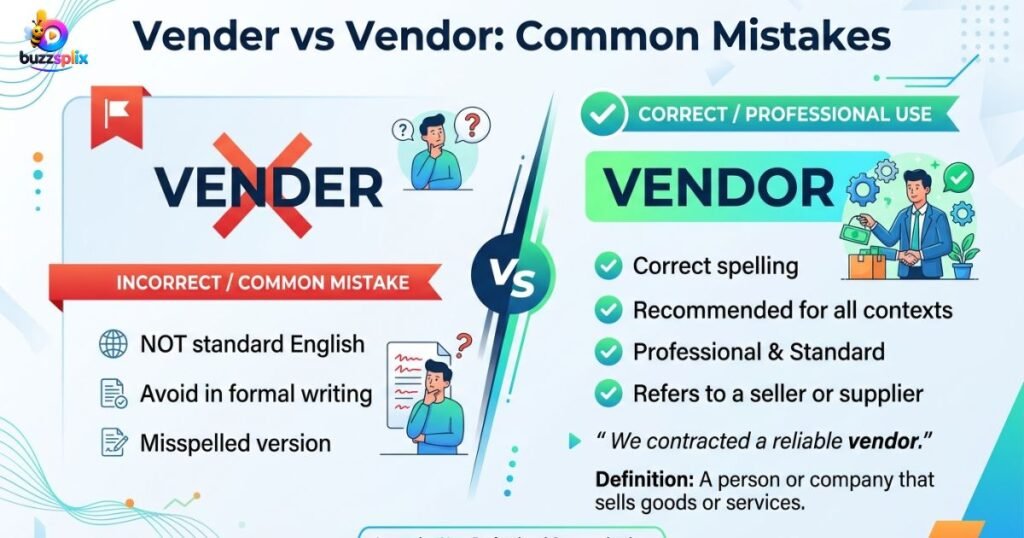
Here are the mistakes people make most often, and how to avoid them:
Mistake 1: Typing “vender” out of habit. This usually happens because the word sounds like it ends in “-er.” Slow down and double-check when writing anything formal.
Mistake 2: Assuming it’s a British spelling. As covered above, this isn’t a US-vs-UK spelling issue. Vendor is correct everywhere in English.
Mistake 3: Confusing it with the Spanish verb. If you’re bilingual or working with translated content, double-check that “vender” wasn’t accidentally carried over from Spanish text.
Mistake 4: Mixing it up with “vending.” “Vending,” as in a vending machine, is related but different. A vendor sells things; vending describes the act or method of selling, especially through machines.
Mistake 5: Confusing vendor with “seller” in legal documents. While the two words are related, “vendor” is the more formal, standard term in contracts, especially real estate and procurement agreements, while “seller” is used more casually.
Vendor in Everyday Examples
Seeing the word in context makes it easier to remember correctly.
- “The food truck vendor sold tacos outside the stadium.”
- “We need to finalize the contract with our software vendor by Friday.”
- “Each vendor at the craft fair had a designated table.”
- “The city requires all street vendors to register for a permit.”
- “Our vendor list includes three suppliers for packaging materials.”
Notice that “vendor” works whether you’re talking about an individual seller, like someone at a farmers market, or a large company supplying goods to a business.
Vendor vs Related Terms: Seller, Supplier, and Distributor
These words overlap but aren’t identical, and mixing them up can create confusion in business writing.
- Vendor: Sells goods or services directly, often used in retail, contracts, and procurement.
- Seller: A general term for anyone selling something, used more casually.
- Supplier: Provides raw materials or products to a business, often before they reach the final customer.
- Distributor: Moves goods from manufacturers to retailers or other businesses, focusing on logistics and distribution rather than direct sales.
A vendor can technically be a type of seller, but not every seller is formally called a vendor. In business contracts, precision matters, so using the right term avoids ambiguity.
How to Remember the Correct Spelling
If you tend to second-guess yourself, try one of these memory tricks:
- Think of the word “or” in “vendor,” similar to “actor” or “creditor,” words describing someone who performs an action.
- Remember that “vender” only exists as a verb in Spanish, never as an English noun.
- Picture a formal contract. Legal documents almost always use “vendor,” which can help anchor the correct spelling in your memory.
Comparison Table: Vender vs Vendor
| Feature | Vendor | Vender |
| Correct in English | Yes | No |
| Part of speech | Noun | Not applicable in English |
| Origin | Latin “vendere” via Anglo-French | N/A (Spanish verb “to sell”) |
| Used in contracts/legal writing | Yes | No |
| Regional spelling difference | Same in US and UK English | Not a recognized variant |
| Common usage | Business, retail, legal, everyday speech | Misspelling or Spanish verb |
Why This Mistake Matters More Than It Seems
A small spelling error like this can affect more than just grammar. In business documents, contracts, or job applications, using “vender” instead of “vendor” can look careless or unprofessional, especially to clients, employers, or legal reviewers who expect precise language.
Search engines and AI writing tools also recognize “vendor” as the standard term, so using the wrong spelling can affect how your content performs in search results or how clearly your message comes across in professional settings.
Conclusion
The correct word is vendor, always. “Vender” isn’t a recognized English word, and confusing the two can make your writing look less polished, especially in professional or legal contexts.
Once you understand where the confusion comes from, sound, spelling habits, or overlap with Spanish, it becomes much easier to remember the right choice. Stick with vendor, and you’ll never have to pause mid-sentence again.
FAQs
Is “vender” ever correct in English?
No. “Vender” is not a standard English word. It only exists as a verb in Spanish, meaning “to sell.”
Why does “vendor” end in “-or” instead of “-er”?
Because it comes from Latin through Anglo-French, where “-or” was used for nouns describing someone who performs an action, similar to “actor” or “creditor.”
Is vendor spelled differently in British English?
No. Vendor is spelled the same way in both British and American English. There is no regional variation for this word.
What’s the difference between a vendor and a supplier?
A vendor typically sells goods or services directly, often to consumers or businesses, while a supplier usually provides raw materials or products earlier in the supply chain.
How can I avoid misspelling vendor in the future?
Remember that “vendor” follows the same pattern as words like “actor” and “creditor.” If your writing tool flags “vender,” trust the correction and use “vendor” instead.