You typed it, stared at it, and now you’re not sure it’s even a real word. Is it “cancellation” or “cancelation”? Your spell checker underlined one of them, but you’ve seen both in emails, headlines, and even official documents.
This mix-up trips up writers constantly, and the confusion between cancellation vs cancelation usually comes down to one small letter that carries a lot of weight: the second L.
Quick Answer
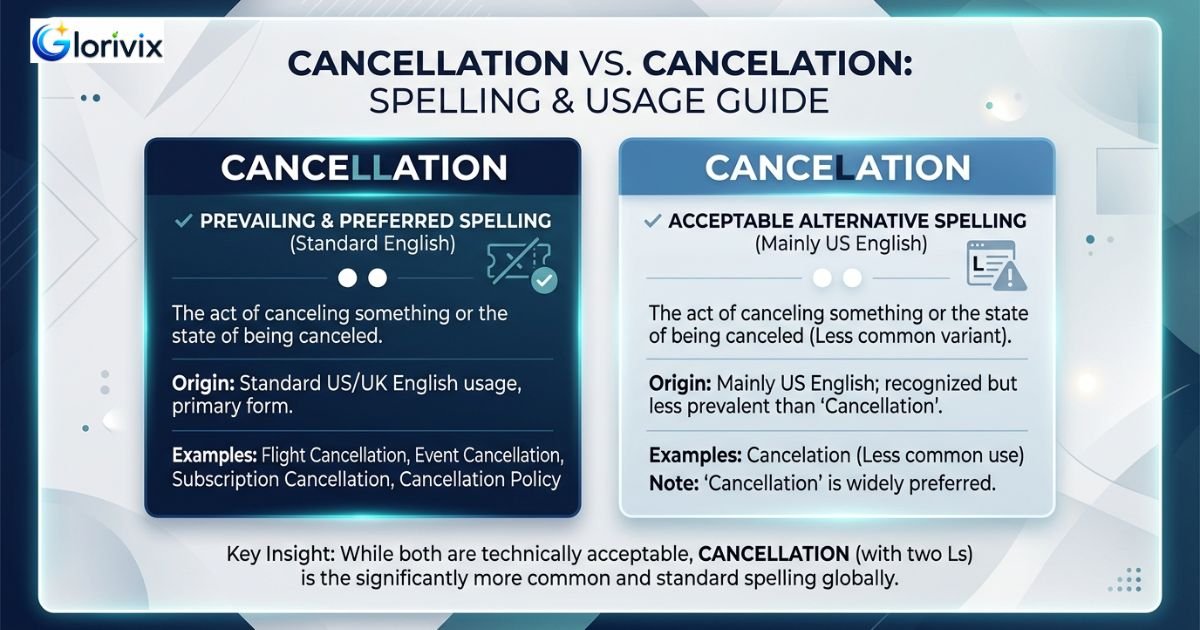
Cancellation (with two Ls) is the correct and standard spelling in both American and British English. Cancelation (one L) is a rare variant that some dictionaries list as acceptable, but it’s almost never used in professional or published writing. If you’re unsure which to use, go with cancellation every time.
Cancellation vs Cancelation: Key Differences at a Glance
Both words mean the same thing: the act of calling something off. The difference is purely spelling, not meaning or pronunciation.
| Feature | Cancellation | Cancelation |
| Spelling | Two Ls | One L |
| Standard in US English | Yes | Rarely |
| Standard in UK English | Yes | No |
| Found in major dictionaries | Yes, primary entry | Yes, listed as variant |
| Used in publishing, news, business | Yes | Almost never |
| Recommended for formal writing | Yes | No |
Why “Cancellation” Uses Two Ls
English spelling rules for verbs ending in a single vowel plus L usually double the L before adding a suffix like -ed, -ing, or -ation. That’s why cancel becomes cancelled, cancelling, and cancellation in traditional usage.
This pattern isn’t unique to “cancel.” It shows up across dozens of common English verbs, which is part of why “cancellation” has stuck as the dominant spelling even in American English, where doubling rules are sometimes relaxed.
Is American English Different Here? Not Really
Most people assume American English always drops the extra letter, the way “color” replaces “colour” or “organize” replaces “organise.” That pattern doesn’t apply to “cancellation.” Both American and British dictionaries treat cancellation as the standard spelling.
The one-L version, “canceled” and “canceling,” does show up more often in American writing for the verb forms, but the noun “cancellation” keeps its double L on both sides of the Atlantic.
This is one of the more confusing exceptions in US spelling, and it catches even experienced writers off guard.
What Dictionaries Actually Say
Merriam-Webster, Oxford, and Cambridge all list cancellation as the primary and preferred spelling. Some dictionaries include cancelation as a secondary or “variant” entry, meaning it exists and won’t get flagged as a made-up word, but it’s not the recommended form.
When a dictionary lists a variant spelling, it’s telling you the word has been used enough to document it, not that it’s equally correct.
Real Examples of “Cancellation” in Sentences
Seeing the word in context makes the spelling easier to remember.
- The airline sent a cancellation notice after the storm grounded every flight.
- Our gym has a 24-hour cancellation policy for class bookings.
- The show’s cancellation disappointed fans who had waited two years for a new season.
- You’ll receive a full refund once the cancellation is processed.
- The event organizers announced the cancellation just three days before the concert.
Notice how naturally the double L sits in each sentence. That familiarity is exactly why “cancelation” tends to look like a typo to most readers, even when it technically isn’t one.
Is “Cancelation” Ever Acceptable?
Technically, yes, in very limited situations. A handful of dictionaries acknowledge it as a valid variant spelling, and it occasionally appears in older texts or specific American publications that favor simplified spelling. But acceptable in a dictionary footnote isn’t the same as expected by your reader.
When cancelation might pass unnoticed:
- Informal personal writing where spelling isn’t scrutinized
- Older American texts from before spelling conventions solidified
- Certain internal company documents with no formal style guide
Where it will almost always look wrong:
- News articles and journalism
- Business correspondence and contracts
- Academic writing
- Any content edited by a professional proofreader
If your goal is to be taken seriously in writing, “cancelation” is a risk that offers no real benefit. Stick with the two-L version.
The Double-L Pattern: Why Other Words Behave the Same Way
“Cancellation” isn’t an isolated case. Several English words that end in a single vowel followed by L double that L before adding a suffix, especially in British English and formal American usage:
| Base Word | With Suffix |
| Travel | Travelling / Traveling |
| Model | Modelling / Modeling |
| Label | Labelling / Labeling |
| Cancel | Cancelling / Canceling |
| Fuel | Fuelling / Fueling |
You’ll notice the verb forms (traveling, modeling, labeling) do vary more between American and British spelling than “cancellation” does. That’s the key distinction: the noun form “cancellation” has settled into one dominant spelling across both dialects, while related verb forms still show regional flexibility. Understanding this pattern helps explain why “cancellation” feels like an exception, when it’s really just more consistent than its cousins.
Common Mistakes Writers Make
A few patterns show up again and again when people get this word wrong.
Mistake 1: Autocorrect confusion. Some autocorrect tools flag “cancellation” as wrong if your language settings are misconfigured, leading writers to “fix” a correctly spelled word.
Mistake 2: Matching it to “canceled.” Since many Americans write “canceled” with one L, they assume “cancellation” should follow the same rule. It doesn’t.
Mistake 3: Copying inconsistent sources. Some websites and apps use “cancelation” inconsistently, which spreads the confusion further.
How to avoid these mistakes:
- Default to “cancellation” unless you have a specific style guide saying otherwise
- Don’t assume verb spelling rules apply directly to the noun form
- When in doubt, check a dictionary rather than relying on memory or autocorrect
Cancellation vs Cancelation in Business and Legal Writing
In contracts, policies, and official notices, consistency matters more than personal preference. Using “cancellation” throughout a document avoids raising questions about typos or unprofessionalism.
Legal and business writing tends to be conservative by nature, and sticking with the widely recognized spelling reduces friction for readers, editors, and anyone reviewing the document later.
If your company has a style guide, check it. Most major style guides, including AP and Chicago, default to “cancellation.”
Final Verdict: Which One Should You Use?
Use cancellation. It’s the standard, expected, and widely recognized spelling in both American and British English, across formal and informal writing alike. “Cancelation” isn’t technically incorrect, but it’s uncommon enough that it will likely be read as a mistake rather than a stylistic choice.
Unless you’re following a specific in-house guideline that says otherwise, the two-L spelling is the safer and more professional option.
Cancellation vs Cancelation: The Bottom Line
When you’re choosing between these two spellings, the decision is simple: go with cancellation. It matches dictionary standards, reader expectations, and professional writing conventions. Save “cancelation” for trivia about English spelling variants, not for your next email or document.
Frequently Asked Questions
Is “cancelation” wrong?
It’s not technically incorrect, since some dictionaries list it as a variant spelling. However, it’s rarely used and often looks like a typo to most readers, so it’s best avoided in professional or formal writing.
Why is “cancellation” spelled with two Ls?
English spelling rules typically double the final L when adding a suffix to a word like “cancel.” This same pattern applies to similar words like “traveling” and “modeling,” though “cancellation” keeps its double L consistently across American and British English.
Which spelling is more common?
“Cancellation” is far more common. It’s the standard spelling used in dictionaries, news outlets, business writing, and everyday communication in both the US and UK.
Is “cancelation” used in American English?
Rarely. While American English does simplify some British spellings, “cancellation” isn’t one of them. The double-L version remains standard in the US, even though the related verb “canceled” often drops the second L.
Does spell check flag “cancelation” as an error?
Most modern spell checkers and word processors will flag “cancelation” or suggest changing it to “cancellation,” since it’s the recognized standard spelling in nearly every style guide and dictionary.
Conclusion
The spelling debate between cancellation and cancelation isn’t really much of a debate at all. Cancellation is the correct, expected, and widely used spelling across American and British English, while “cancelation” remains a rarely used variant that most readers will interpret as a mistake.
When you’re writing anything meant to look polished, whether it’s a business email, a policy document, or a simple text message, choosing “cancellation” keeps your writing clear, correct, and easy to trust.