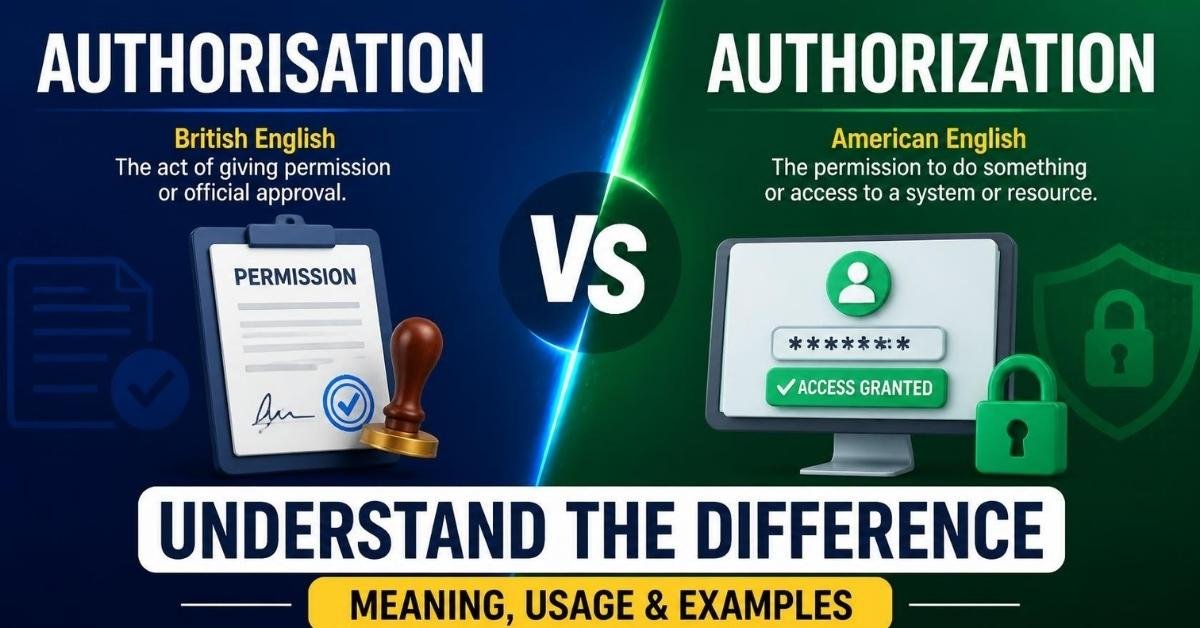
Have you ever written a word correctly but still wondered why someone else spelled it differently? Authorisation vs authorization is one of those confusing spelling differences that can make writers pause. Both versions are correct, and they carry the same meaning. The only difference comes from where the English style is used. American English follows authorization, while British English commonly uses authorisation.
This small spelling change appears in many important areas, including business, banking, legal documents, and technology. Choosing the right form can make your writing look more professional and consistent. In this guide, you’ll learn the meaning, history, examples, and real-world uses of these terms so you can confidently pick the correct spelling every time.
Quick Answer
The simple answer is that authorization and authorisation are both correct spellings. The difference depends on the type of English you use.
In the United States, writers usually choose authorization. In the UK and some other regions, people often use authorisation.
Both words have the same meaning. They describe official permission, approval, or consent to do something.
| Spelling | Used In | Meaning |
| Authorization | American English | Official permission or approval |
| Authorisation | British English | Official permission or approval |
For example:
- The manager gave authorization for the project.
- The hospital received authorisation before the medical procedure.
When comparing authorisation vs authorization, remember that the meaning stays the same. Only the spelling changes.
The Origin of the Word Authorization

The word authorization comes from the idea of authority, which means power, control, or the right to make decisions.
Its roots go back to Latin, where words connected to power and influence developed. Later, Old French and Middle English helped shape the term used in English today.
Over time, Modern English created different spelling patterns across regions.
Language experts study these changes through areas like:
- Orthography – the study of correct spelling
- Morphology – how words are formed
- Syntax – how words work in sentences
The spelling difference between authorization and authorisation is not about meaning. It happened because English developed differently in various countries.
For example:
Older usage:
- Authority gave someone the right to act.
Modern usage:
- The company provided authorization before releasing information.
Today, dictionaries such as the Oxford English Dictionary, Merriam-Webster, Cambridge Dictionary, and Collins Dictionary recognize both forms.
British vs American English Spelling

English changes depending on where it is spoken. This is why British English and American English often use different spellings.
American English commonly uses -ization, while British English often prefers -isation.
Examples:
| American English | British English |
| Authorization | Authorisation |
| Organization | Organisation |
| Realization | Realisation |
These differences are part of English spelling rules, not grammar mistakes.
Writers who create content for global audiences often follow International English or specific style guides to keep spelling consistent.
For example:
American company:
The customer needs authorization before accessing the account.
British company:
The customer needs authorisation before accessing the account.
Both sentences are correct.
The important thing is consistency. Mixing both styles in the same document can make your writing look unpolished.
Meaning and Definition of Authorization
Authorization means giving someone official permission to perform an action.
A person, company, government office, or digital system can provide authorization.
It usually involves approval from someone with proper authority.
Common examples include:
- Permission to access information
- Approval to complete a transaction
- Consent for a medical procedure
- Validation before an important action
Authorization works closely with related terms like:
- Authentication
- Verification
- Validation
- Permission
- Approval
- Consent
However, these words have different roles.
For example:
Authentication asks:
Who are you?
Authorization asks:
What are you allowed to do?
A simple conversation:
Employee: Can I access the financial report?
Supervisor: You need authorization before opening that file.
The supervisor checks whether the employee has the correct permission.
Authorization in Business and Professional Communication
Businesses use authorization every day to control decisions and protect important resources.
Companies create clear processes so employees know who can approve specific actions.
Common business examples include:
- Project approval
- Budget spending permission
- Managerial consent
- Executive decision making
- Finance department approval
- Corporate policies
For example, a company may require authorization before spending thousands of dollars on a new project.
A conversation might look like this:
Employee: Can we purchase the new software?
Manager: The finance department needs to provide authorization first.
Authorization helps organizations avoid mistakes and maintain responsibility.
A CEO may authorize major decisions, while a supervisor may approve smaller workplace actions.
Without proper authorization, companies may face financial problems or security risks.
Clear approval systems keep business operations organized and trustworthy.
Authorization in Banking and Digital Transactions
Banks use authorization to protect customers and prevent financial problems.
Every time you make an online payment, the system checks whether the transaction has proper approval.
This process may include:
- Payment authorization
- Transaction verification
- Identity validation
- Security confirmation
For example, when you buy something through online shopping, your bank confirms that you have permission to complete the payment.
A simple example:
Customer: Why did my payment fail?
Bank: The system could not complete the authorization process.
Banks use these checks to reduce fraud and stop unauthorized activity.
Digital payment systems combine authorization with authentication.
Authentication confirms your identity through passwords, codes, or biometrics.
Authorization decides whether you can complete the requested action.
Modern cybersecurity systems use these methods to protect customer accounts and sensitive financial data.
Authorization in Law and Government
Law and government systems use authorization to confirm that a person or organization has official permission to take an action.
Government agencies often require authorization before allowing activities that affect public safety, businesses, or citizens.
Common examples include:
- Permits for construction projects
- Import and export approvals
- Regulatory compliance checks
- Government licenses
- Legal documentation
For example, a company cannot begin certain construction work without approval from the city council.
A conversation may look like this:
Builder: Can we start the construction project now?
Official: You need government authorization before beginning the work.
Legal authorization often includes:
- Official signatures
- Written agreements
- Approved documents
- Permission from legal authorities
In legal environments, authorization proves that someone has the right to act on behalf of another person or organization.
The difference between authorisation vs authorization only depends on spelling style. The legal meaning remains the same in both British English and American English.
Authorization in Technology and Cybersecurity
Technology systems use authorization to control access to information and digital resources.
It helps companies decide what users can view, change, or manage inside a system.
Modern cybersecurity frameworks use authorization along with authentication to protect sensitive data.
Important technology concepts include:
- Access control
- Role-based access control
- User authentication systems
- Administrative permissions
- Cloud security platforms
For example, logging into an account requires authentication. However, opening a private company file requires authorization.
A simple conversation:
Employee: Why can’t I open this document?
IT Manager: Your account needs authorization for that file.
Authorization helps prevent data breaches by limiting access to approved users.
Companies use permission settings to protect customer details, financial records, and private information.
Whether you write authorization or authorisation, the concept stays unchanged. The spelling depends on regional English preferences.
Common Mistakes with Authorization or Authorisation
Many people confuse authorization and authorisation because both spellings look slightly different.
The biggest mistake happens when writers mix American English and British English in the same document.
For example:
❌ The company received authorization and later updated the authorisation form.
✅ The company received authorization and updated the authorization form.
or
✅ The company received authorisation and updated the authorisation form.
Other common mistakes include confusing authorization with similar terms.
Remember:
- Authentication confirms who someone is.
- Authorization confirms what someone can do.
- Verification checks whether something is accurate.
- Validation confirms that something meets requirements.
A quick conversation:
Writer: Are authorization and authentication the same?
Editor: No. Authentication checks identity, while authorization gives permission.
When writing professionally, choose one spelling style and follow it consistently.
Related Words and Vocabulary
Several words connect closely with authorization because they describe permission, approval, and decision-making.
Understanding these related terms helps you use the word correctly.
Important vocabulary includes:
- Authority – the power or right to make decisions
- Permission – approval to do something
- Approval – official agreement
- Consent – permission given willingly
- Verification – checking accuracy or truth
- Authentication – confirming identity
- Validation – confirming that something meets standards
For example:
A manager has the authority to approve a project.
The employee receives permission to complete the task.
The system performs authentication before granting access.
These words appear often in:
- Business communication
- Legal documents
- Banking systems
- Cybersecurity reports
- Workplace policies
The terms may seem similar, but each one has a different purpose.
The spelling difference in authorisation vs authorization does not change these related meanings.
Real-World Example Sentences
Seeing real examples makes it easier to understand how people use authorization in daily situations.
Business example:
The CEO gave authorization for the company to launch the new project.
Banking example:
The bank completed payment authorization before processing the online purchase.
Medical example:
The hospital requested authorization before performing the surgical procedure.
Technology example:
The system requires authorization before allowing users to access private files.
Government example:
The company received official authorization from the city council before starting construction.
Workplace example:
The supervisor provided authorization for the employee to access confidential reports.
A short conversation:
Customer: Why do I need authorization for this request?
Agent: It protects your information and confirms that you have permission.
Whether you use authorization in American English or authorisation in British English, the meaning stays focused on official approval and controlled access.
Final Insights
Understanding authorisation vs authorization becomes simple once you know the main difference. Both words have the same meaning and refer to official permission, approval, or the right to take action. The difference only comes from spelling styles. American English uses authorization, while British English uses authorisation.
When you write about authorisation vs authorization, choose the spelling style that matches your audience. Use authorization for US readers and authorisation for UK readers. Keeping your choice consistent makes your writing clear and professional. Whether you see authorisation vs authorization in business, banking, law, or technology, remember that both forms are correct. Learning this small difference helps you communicate better and avoid common spelling mistakes in everyday and professional writing.
FAQs
Is authorization or authorisation correct?
Both are correct spellings in authorisation vs authorization. American English uses authorization, while British English uses authorisation.
Which spelling should I use in international writing?
Use one style consistently when writing about authorisation vs authorization. Follow your audience, region, or preferred style guide for spelling choices.
What does authorization mean?
Authorization means official permission, approval, or consent to perform an action. In authorisation vs authorization, both words have the same meaning.
Is authorization used in technology?
Yes, technology systems use authorization to control access and protect data. It works with authentication in cybersecurity and digital platforms.
What is the difference between authorization and authentication?
Authorization gives permission, while authentication confirms a user’s identity.In authorisation vs authorization, both spellings describe granting access rights.
Is authorization used in banking?
Yes, banks use authorization for payments, transactions, and security checks. It helps prevent fraud and unauthorized activity during financial operations.