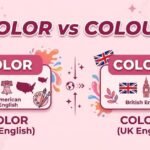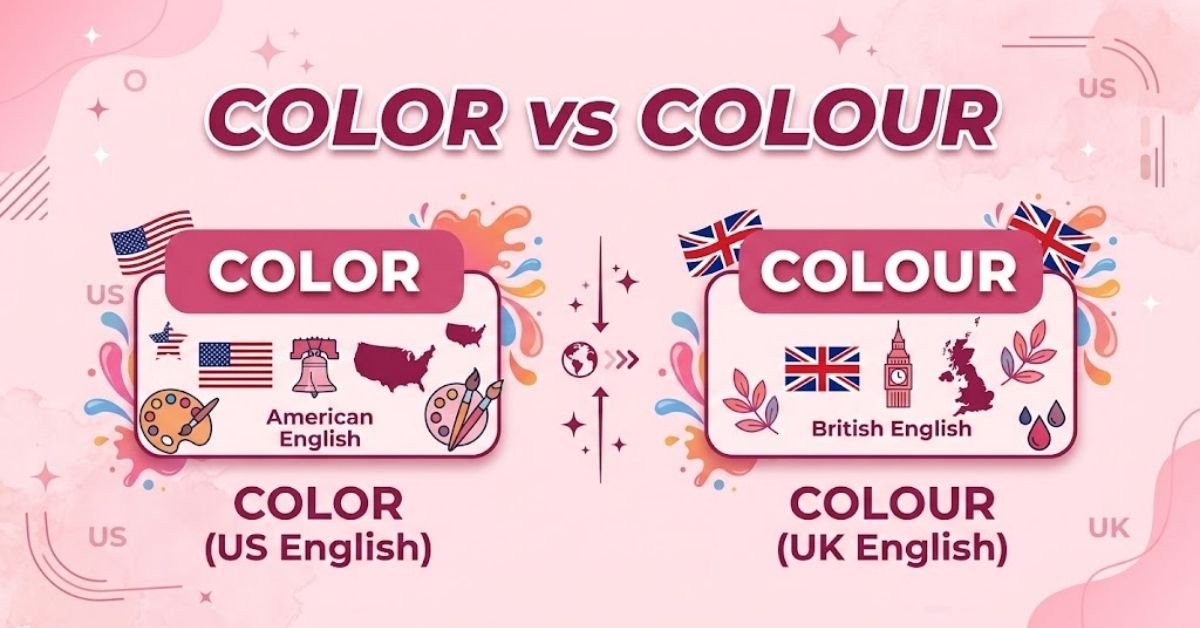
You’re typing an email to a client in London. Or a school essay for a teacher in Toronto. Your cursor freezes. Is it color or colour?Both are correct. Color is the standard American spelling, and colour is the standard UK spelling. Pick the one your audience expects, then stick with it.
This guide covers the rule, the reason behind it, and real examples you can copy. By the end, you won’t second-guess this word again.
Quick Answer
Use color for a US audience and colour for a UK audience. That’s the whole rule. Neither one is a typo, and neither is “more correct” in every situation.
Canadian English, Australian English, and most Commonwealth English writers use colour. If your readers are American, drop the u. If they’re British, keep it.
- Color: American English, the standard US spelling
- Colour: British English, plus Canada, Australia, and most international English writing outside the US
Why People Confuse Them

Same word, same sound, two spellings. That’s a perfect recipe for doubt. You’ve probably seen both online for years, so neither looks wrong on its own.
Software adds to the mess. Spellcheck set to English (US) underlines colour in red, while English (UK) does the reverse. Plenty of writers switch settings without noticing.
The internet blurs things further. A British blogger reads American sites all day, and an American student binges British YouTube. So the mixed audience is now normal, and regional spelling rules feel fuzzy.
Key Differences At A Glance
Here’s the side-by-side view. You’ll notice the only real change is one letter.
| Feature | Color | Colour |
| Variety | American English | British English |
| Where it’s used | United States | UK, Canada, Australia, most Commonwealth countries |
| Meaning | Hue, shade, tint | Hue, shade, tint |
| Pronunciation | KUH-ler | KUH-ler |
| Related forms | colored, coloring, colorful | coloured, colouring, colourful |
| Verb form | to color | to colour |
So the spelling differences stop at the letter u. Meaning, grammar, and sound all stay the same.
Are They the Same Word?
Yes. They’re two spellings of one word, with one dictionary definition. Color and colour both name a visual quality, like red, green, or blue. As a noun, it’s the hue you see. As a verb, it’s what a kid does when they fill in a drawing.
This isn’t like “complement” and “compliment,” where a different spelling means a different thing. Nobody will misread your sentence because you dropped the u. The difference is language variation, not word meaning.
What about pronunciation? Both say KUH-ler, so the identical pronunciation surprises nobody. Regional pronunciation does shift a little, though. American pronunciation sounds the final r, while many British pronunciation patterns soften it. That’s an accent thing, not a spelling thing.
US vs UK Preference
In the United States, color is the only spelling you’ll see in schools, newspapers, and official documents. Writing colour in an American essay may earn a red mark. American readers just expect the shorter form.
In the UK, colour wins the same way. British readers see color as an Americanism. Canada, Australia, New Zealand, Ireland, India, and South Africa mostly follow the British-style spelling for this word.
Canada is a fun edge case. Canadians write colour but often borrow other American habits, so their English sits between the two camps. If you write for Canadian audience members, colour is the safe pick.
A Quick History: Why Americans Dropped the U
The -our endings came into English through French after the Norman Conquest. Words like colour, honour, and labour picked up that shape and kept it for centuries. Latin, the older source, used -or endings.
Then came Noah Webster. In the early 1800s he pushed for simpler, more logical spelling, and he wanted a standard that felt distinctly American. His 1828 American Dictionary helped lock in color, honor, and labor.
Britain never adopted those American spelling reforms. So the two forms stuck, each backed by its own dictionaries. Today, Webster’s dictionaries still stand as a symbol of American English history.
Which Spelling Should You Use?
Start with your readers, not your own habit. Ask who will open this page, email, or file. Then match them.
Here’s a quick decision path:
- Know your audience. US readers get color. UK readers get colour.
- Check the rules. A teacher, editor, or employer may set the chosen spelling style for you.
- Match your tool. Set your spellchecker to the same variety you’re writing in.
- Mixed crowd? Pick one and stay consistent. Don’t switch halfway through.
Audience expectations matter more than personal taste. If your international audience is split, follow the local standards of your biggest group. Consistency beats perfection here.
When One Spelling Looks Wrong
Colour looks fancy, or even wrong, to many Americans. Color looks clipped to many Brits. That feeling comes from familiarity, not from correctness.
Here’s a quirk that trips up even confident writers. British English keeps the u in honour, but drops it in honorary and honorific. Humour becomes humorous, and labour becomes laborious. So a UK writer isn’t always using -our.
Some words never change at all. Doctor, actor, error, and motor take -or everywhere. If a spelling looks off, check whether the word belongs to the -our family before you “fix” it.
Common Mistakes (and Quick Fixes)
Most errors come from inconsistent spelling, not from not knowing the rule. Here are the ones that show up most.
| Mistake | Quick fix |
| Mixing color and colour in one document | Choose one, then run find and replace |
| Mixing US and UK spelling in related words | Match every form to your style |
| Treating British spelling as fancier | It’s just regional, not classier |
| Treating American spelling as universally correct | It’s correct for US readers only |
| Forgetting related forms like colourful | Check colored, coloring, and colorful too |
| Changing brand names or quotations | Keep the original spelling |
The last one matters most. If a company’s official name uses one spelling, leave it alone. The same goes for product titles and any quotations you copy.
Everyday Examples
Seeing the word in action helps more than any rule. These pairs show how the two spellings work in example sentences.
- Email (US): “Can you send the logo in color?”
- Email (UK): “Can you send the logo in colour?”
- School (US): “The poem uses red as a symbol of anger, and that color repeats.”
- School (UK): “The poem uses red as a symbol of anger, and that colour repeats.”
- Design (US): “Our color palette needs a warmer tone.”
- Design (UK): “Our colour palette needs a warmer tone.”
Picture a student who moves from Manchester to Boston. Their first American essay comes back with “colour” circled. The teacher isn’t wrong, and neither is the student. It’s just a different spelling guide.
Phrases follow the same pattern. “True colors” becomes “true colours” in the UK. “Color scheme” and “colour scheme” are twins. Schoolwork, blogs, and business documents all follow the reader’s variety.
Related Word Forms Cheat Sheet
Once you pick a side, every related word form follows. This table keeps them straight.
| US spelling | UK spelling |
| Color | Colour |
| Colored | Coloured |
| Coloring | Colouring |
| Colorful | Colourful |
| Discolor | Discolour |
| Honor | Honour |
| Labor | Labour |
| Favor | Favour |
| Humor | Humour |
Notice the pattern? Every US word drops the u, and every UK word keeps it. Learn it once, and you’ve solved a whole family of word choice questions.
Watch out for one real-world twist. The Australian Labor Party spells Labor without the u, even though Australians write labour in everyday text. That’s an official name, so it stays as written.
Color in Design, Code, and Digital Content
Designers and developers hit this issue daily. In CSS, the property is always color, and background-color follows the same rule. A UK developer still has to write the American spelling in code.
That doesn’t force it onto your page text. A British site can say “choose your colour” in the copy and still use color in the stylesheet. The two live in separate worlds.
For digital content and professional writing, decide your spelling style early. Put it in your style notes so every writer on the team follows it. Good spelling consistency saves hours of cleanup later.
Dictionary-Style Word Details
Want the quick reference version? Here it is in dictionary-style details.
- Word: color (US) or colour (UK)
- Part of speech: noun and verb
- Pronunciation: KUH-ler
- Definition (noun): the visual quality of an object, such as hue, shade, tint, or tone
- Definition (verb): to add color, as with dye or paint, or to fill in an image
- Synonyms: hue, shade, tint, tone, tinge, pigment
- Verb alternatives: to tint, to dye, to paint, to shade
- Example (noun): “Green is her favorite color.”
- Example (verb): “He’ll color the map before class.”
The color meaning and colour meaning are identical here. Any color definition you find in an American dictionary matches the colour definition in a British one.
Conclusion
Color and colour are the same word in two outfits. Color suits US English, and colour suits UK English. Your job is to match your reader and stay consistent.Keep related forms in line, protect brand names and quotes, and set your spellchecker to the right variety. Do that, and you’ll avoid nearly every common mistake we covered.
Which spelling do you use, and where do you write from? Drop a comment below, and share this guide with a friend who keeps mixing them up.
FAQs
Is color or colour correct in the US?
Color is correct in the US. It’s the standard American spelling used in schools, media, and business. Colour would look out of place to most American readers.
Do color and colour mean different things?
No. They have the same meaning, the same pronunciation, and the same grammar roles. Only the regional spelling changes.
How should I handle related forms like colored/coloured?
Match them to your main choice. If you write color, use colored, coloring, and colorful. If you write colour, use coloured, colouring, and colourful.
Should I change brand names to match my spelling style?
No. Brand names, official names, and quotations should keep their original spelling. Changing them can confuse readers and even misquote a source.
Why do Americans spell color without the “u”?
Mostly because of Noah Webster. He promoted simplified -our endings in the early 1800s, and his dictionaries made the shorter form the American norm.