You’re typing a formal email, and the salutation stops you cold. Is it Dear Madam or Dear Madame? It’s a tiny choice, but it can make a professional message look careless.
Here’s the short answer. Use madam in English writing, and save madame for French contexts, French names, and titles like Madame Curie. This guide covers the meaning, origin, and usage tips, so you won’t second guess it again.
Quick Answer
The madam vs madame question gets easy once you know which language you’re writing in. Let’s sort it out fast.
Meaning
Madam is the English form of address for a woman. It’s a polite form of address you’ll see in formal letters, customer service, and official writing.
Madame is the French version. It carries the same idea, a respectful form of address, but it belongs to French usage and shows up in English as a borrowed word.
Examples
“Dear Madam, I’m writing about my recent order.” That’s standard English. “Madame Dupont will join us from Paris.” That’s a French context.
A bank clerk might ask, “How can I help you, madam?” A host in Lyon would say, “Bonjour, madame.” The respect matches. The language doesn’t.
Final Answer
Use madam in standard English form. Use madame only when the French cultural context calls for it.
Not sure? Pick madam. It’s the safe choice for nearly every professional setting in English worldwide.
The Origin of Madam or Madame
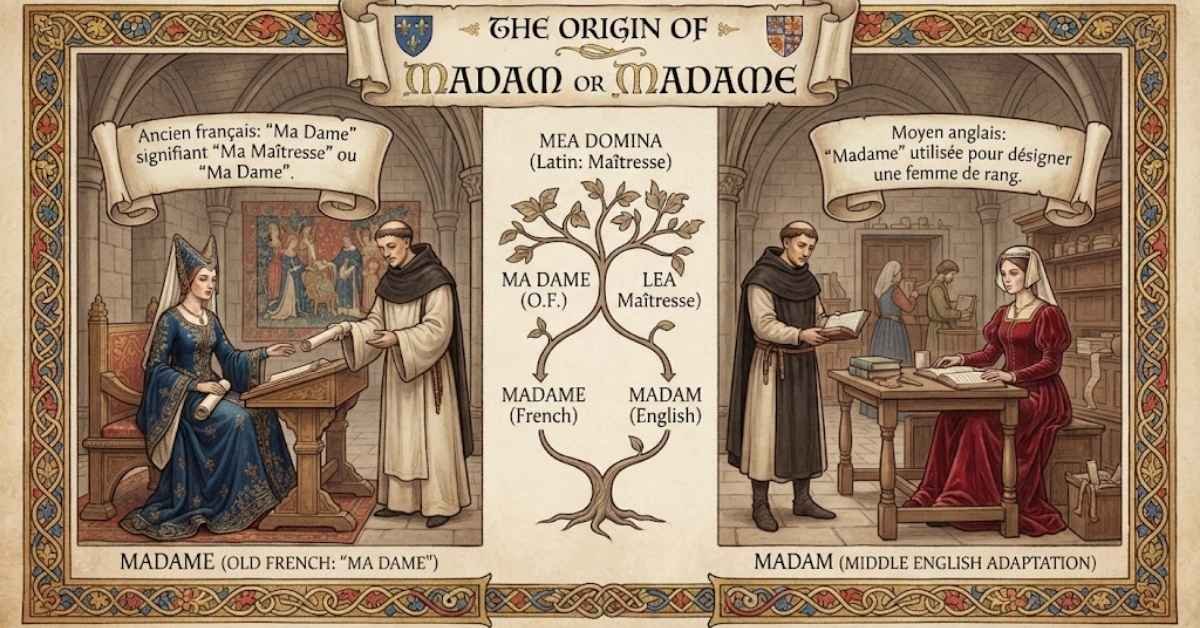
Words carry baggage from wherever they’ve traveled. This pair has a short but interesting trip from French into English.
History
Both words trace back to the French phrase “ma dame,” which means “my lady.” It grew from Latin roots that meant something like “my mistress” or “my lady of the house.”
English picked it up in the Middle Ages, back when French terms flooded into the English language through courts and trade. That’s a classic case of French influence on English.
Evolution
Over time, English speakers trimmed the ending and softened the sound. Madame became madam, and the pronunciation shifted toward a plain “MAD-um.”
The French kept the original spelling and the sound. So you ended up with an English adaptation and a French origin form sitting side by side.
Why the Difference Exists
It’s not a typo or a regional quirk. It’s linguistic adaptation in action, where English borrowing reshaped a word to fit English vocabulary.
Think of it like a family recipe. The English branch simplified it, and the French branch kept the original. Both versions are still on the menu.
British English vs American English Spelling
Many confusing words split along a British vs American English line, like colour and color. This one doesn’t.
Usage Comparison
Both British English and American English spell it madam. There’s no separate British English spelling or American English spelling of madame either, because madame is French spelling.
Habits do differ a little. Dear Sir or Madam feels very natural in British letter writing, while American writers often lean toward a name or a neutral greeting.
Key Insight
The real split is English vs French, not UK versus US. Once you see that, the whole spelling comparison clicks.
So don’t ask which country you’re writing for. Ask which language and cultural context you’re in.
Which Spelling Should You Use?
Your answer depends on the setting. Here’s how to decide without overthinking it.
Formal Writing
In formal writing, business communication, and official communication, go with madam. It’s the correct spelling for the English form of address.
You’ll see it in phrases like “Dear Madam,” “Madam Chair,” and “Madam President.” These are the formal address terms readers expect.
Cultural or Stylistic Use
Use madame when you’re referencing French names, French cultural references, or a historical reference tied to France. Madame Bovary and Madame Tussauds are good examples.
It also works for stylistic use, like a café name or a fashion brand that wants a Parisian feel. Here the French flavor is the whole point.
Safe Choice
When in doubt, madam wins. It’s correct English in nearly every professional conversation.
Better yet, skip the guesswork when you can. If you know the person’s name, use it.
Common Mistakes with Madam or Madame
Most writing mistakes here come from good intentions. People want to sound polished and overshoot.
Using Madame in Formal Emails
Writing “Dear Madame” in an English business email is the top slip. It reads as an accidental French spelling in an English message.
The fix takes two seconds. Change it to Dear Madam, or better, to the recipient’s name.
Mixing Contexts
Some writers blend both, like “Madame Manager” in an English memo. That mashes French and English in a way readers find odd.
Keep each context clean. English sentence, madam. French name or cultural reference, madame.
Overcomplicating
Others worry so much they add extra words, like “Dear Madam or Madame.” That just confuses the greeting.
You only need one. Choose based on language, and move on.
Madam or Madame Meaning (Detailed)
Now let’s look at what each word meaning covers, including the side uses that surprise people.
Madam Meaning
Madam is a polite form of address for a woman, especially in formal situations. It works for a customer, a manager, or any woman you’re addressing with respect. It doesn’t depend on marital status.
It also appears in titles, like “Madam Speaker.” Casual speech shortens it to ma’am. In British English, “a little madam” can describe a cheeky girl, and the word can also mean a woman who runs a brothel, though that’s a specific usage you’ll rarely need.
Madame Meaning
Madame is the French title for a woman, roughly like Mrs. or “Ms.” in English. Its abbreviation is Mme, and its plural is Mesdames.
In English, you’ll meet it in names and cultural usage. Think of Madame Curie, the scientist behind major discoveries in radioactivity, or French titles in novels and films.
Madam or Madame in Everyday Examples
Rules make more sense with real sentences. Here’s how it looks in daily writing.
Say you’re contacting a company and don’t have a name. “Dear Madam,” or “Dear Sir or Madam,” works as a classic email greeting.
Say you’re writing to a French colleague in French. “Chère Madame,” is right, because you’re in a French context.
Formal Writing
In a formal letter or a speech, you might write “Madam Chair, I’d like to raise a point.” That’s textbook formal communication.
In a report about French history, you’d write “Madame de Pompadour”. The French spelling stays because it’s a name.
Cultural Reference
You’d say “Madame Curie” when talking about Marie Curie, since that’s how she’s widely known. Madame Tussauds keeps its French title too.
That’s why you’ll see madame all over English cultural usage. It’s a name, not a greeting.
How to Pronounce Madam and Madame
Sound matters when you’re speaking or recording a video. The two words don’t sound alike.
Madam is said like “MAD-um” in English, with stress on the first part. Madame in French sounds closer to “mah-DAHM,” with a softer, nasal finish.
English speakers often say madame with a French flair when they mean the French title. If you’re introducing Madame Curie in a talk, either version is understood, but the French one shows care.
Madame in Names, Titles, and Pop Culture
Madame isn’t just a title. It’s stuck onto famous names and brands, which keeps it alive in English vocabulary.
Marie Curie is often called Madame Curie, and she’s tied to the discoveries of polonium and radium. Madame Tussauds is the wax museum, and Madame Bovary is the novel.
So even if you never write “Dear Madame,” you’ll still bump into it. That’s why writers keep asking about this word choice.
Related Terms: Ma’am, Mesdames, and Mme
A few similar-looking words and abbreviations show up next to these two. Let’s clear them up.
Ma’am is a shortened, spoken form of madam. It sounds friendly and is common in American speech. Mesdames is the French plural of madame, and Mme is the written short form.
Don’t mix them up in written English. Use madam or ma’am in English sentences, and keep Mme and Mesdames for French text or names.
Is Madam Still Right for Emails in 2026?
Times change, and so does email etiquette. Many workplaces now prefer a name or a neutral greeting over gendered ones.
If you can find the person’s name on a company page or LinkedIn, use it. If you can’t, “Hello team,” or “Dear Hiring Manager,” feels current, while Dear Madam still works in formal letter writing.
Also keep in mind that some readers find “Sir or Madam” dated. So match the tone of the company and the situation, then decide.
Madam or Madame – Google Trends & Usage Data
I’m not going to invent numbers here. For exact figures, open Google Trends and compare the two terms in your target country.
What you can expect is a pattern. Madam tends to draw broader everyday usage because it fits business communication and common phrases. Madame is more limited usage, often tied to French names and brands.
Popularity
Popularity shifts with events. A film, a museum exhibit, or a Madame Curie anniversary can lift madame for a while.
Madam usually holds steady because it’s tied to formal greetings people use all year. That’s a useful signal for writers choosing the more common usage.
Global Insight
Worldwide usage varies by region. Countries with strong French cultural ties may see more madame in searches.
In markets where English is the main language, madam leads for correct word choice questions. Try a country filter in Google Trends to see your audience.
Comparison Table: Madam vs Madame
Here’s a quick side by side you can bookmark.
| Feature | Madam | Madame |
| Language | English | French |
| Pronunciation | MAD-um | mah-DAHM |
| Short form | Ma’am (spoken) | Mme (written) |
| Plural | Madams (Mesdames in formal use) | Mesdames |
| Typical use | Formal emails, letters, customer service | French names, culture, French text |
| Safe in English emails | Yes | Rarely |
| Example | “Dear Madam,” | “Madame Curie” |
Conclusion
The madam or madame puzzle is really about language. Use madam for the English form of address. Use madame for French names, titles, and cultural context.
If a real name is available, use that instead. Got a tricky greeting you’re stuck on? Drop it in the comments, and share this with a friend who’s still writing “Dear Madame.”
FAQs
Is it Dear Madam or Dear Madame?
Use Dear Madam in English. Dear Madame only fits when you’re writing in French or to a French speaker.
Is madame correct in English?
Yes, but mostly in names and French titles. It’s not the standard greeting in English worldwide.
Is madam outdated?
Not completely. It still fits formal letters, but many writers now prefer a name or a neutral opener.
Can I use madam for an unmarried woman?
Yes. Madam doesn’t signal marital status. It’s a respectful address for any adult woman.
Is ma’am the same as madam?
Ma’am is a spoken short form of madam. It sounds warmer and is common in American speech.
What does Mme stand for?
Mme is the French abbreviation for madame. Its plural short form is Mmes, for Mesdames.
Where can I check the dictionary definition?
Look up madam and madame in a trusted dictionary like Merriam-Webster. It confirms the definition, spelling, and usage.