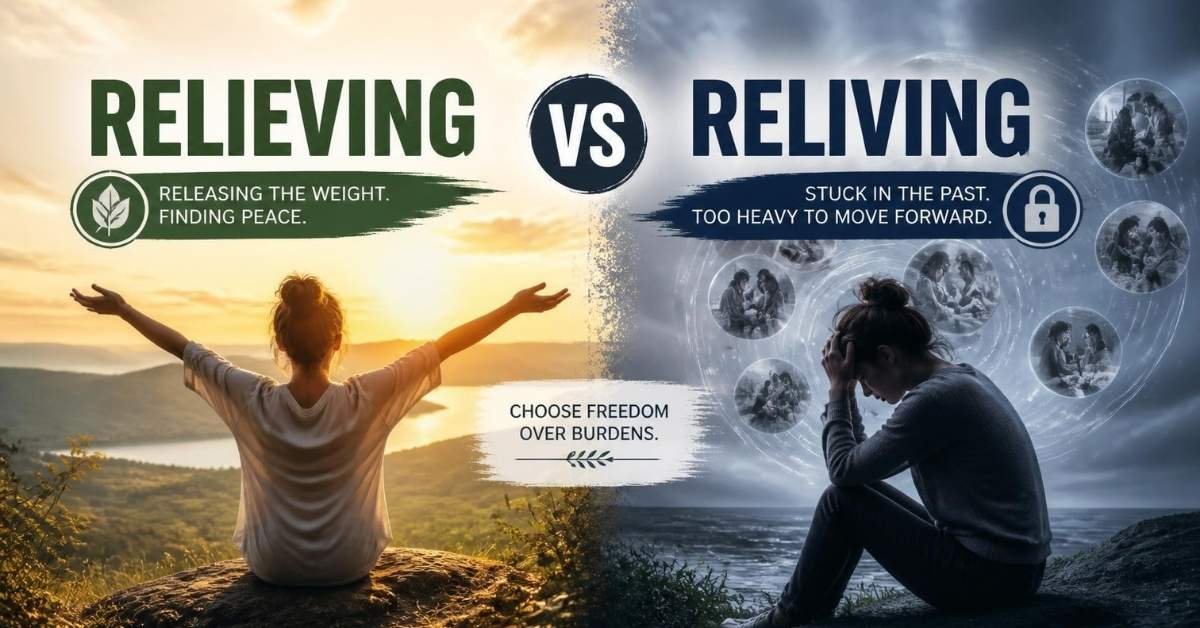
You typed a sentence, then paused. Is it “relieving my stress” or “reliving my stress”? That tiny letter swap changes everything.Here’s the quick fix. Relieving means making pain, pressure, or discomfort go away. Reliving means experiencing something from your past all over again, usually in your mind. One is about comfort. The other is about memory.
This mix up trips up students, bloggers, and even professional writers. It’s an easy trap because the words sound almost identical when spoken fast. But once you see the pattern, you’ll never confuse them again.
Quick Answer: Relieve vs Relive

Think of it this way. Relieve comes with pain, stress, or pressure attached. You relieve a headache. You relieve tension in your shoulders. You relieve someone’s worry.
Relive, on the other hand, always connects to a memory or a past experience. You relive your wedding day. You relive a scary accident. You relive childhood memories every time an old song plays.
The core difference sits in the direction each word points. Relieving looks forward, toward comfort and relief. Reliving looks backward, toward something that already happened.
Simple Examples
- A hot bath is great for relieving muscle tension after a long run.
- Watching old family videos can make you feel like you’re reliving your teenage years.
- The doctor gave her medication for relieving chronic pain.
- He couldn’t stop reliving the traumatic crash in his dreams.
Notice how relief always pairs with something uncomfortable getting smaller. Reliving always pairs with a scene playing again in your head.
Relieving or Reliving Origin
Both words trace back to the same Latin root, which is exactly why they look so similar on paper. That shared ancestry is part of what makes this pair so confusing for English learners and native speakers alike.
History of Relieving
Relieve comes from the Latin word relevare, meaning to lift up or lighten. Old French picked it up, and Middle English borrowed it from there. The idea of lifting a burden stuck around for centuries, which is why we still talk about relieving weight, relieving pressure, and relieving pain today.
History of Reliving
Relive is built differently. It’s simply the prefix re-, meaning again, attached to the verb live. So reliving literally means to live again. English loves stacking re- onto verbs to show repetition, and reliving followed that same pattern as storytelling and memoir writing grew more popular.
British and American English: Any Difference?
Good news here. Both British English and American English spell and use these words the exact same way. There’s no regional twist, no extra letter, no swapped vowel like you’d see with words such as color and colour.
Whether you’re writing for a UK audience, a US audience, or somewhere in the Commonwealth, relieve and relive stay consistent. That’s rare in English, so enjoy the simplicity while it lasts.
Choosing the Correct Word in Context
The fastest trick is asking yourself one question. Am I talking about reducing something, or remembering something? If your sentence is about reducing pain, reducing stress, or reducing discomfort, you want relieving.
If your sentence is about remembering the past, replaying old events, or recalling events in vivid detail, you want reliving. This one filter solves almost every mix up instantly.
Audience Advice
If you’re writing for students, keep this rule handy for essays and grammar exercises. If you’re a content creator or blogger, double check this pair before hitting publish, since it’s one of the most searched commonly confused words online.
Writers working on memoirs, therapy blogs, or wellness content will use both words constantly, often in the same paragraph. Getting the split right builds trust with readers who notice these details.
Common Errors Writers Make
The most frequent mistake is swapping relieving in place of reliving when describing a memory. Someone might write “she was relieving her college days” when they actually mean she was reliving them.
Another common slip happens with spelling under pressure, especially in fast typing or texting. Spelling confusion between these two words shows up often in emails, captions, and quick messages where nobody proofreads twice.
- Wrong: I love relieving my childhood summers at the lake.
- Right: I love reliving my childhood summers at the lake.
- Wrong: This tea helps with reliving anxiety before bed.
- Right: This tea helps with relieving anxiety before bed.
Everyday Examples in Different Settings
Context changes how often you’ll see each word. Some settings lean heavily toward one meaning over the other.
Emails and Messages
In email writing, relieving shows up when discussing workload, deadlines, or stress. “This update should be relieving some of the pressure on your team” is a common phrase in professional messages.
Journalism and Reports
News reports often use reliving when interviewing survivors or witnesses of a disaster or accident. Journalists frequently write about people reliving traumatic moments during interviews or documentary filming.
Social Media Posts
Social media posts and captions use reliving constantly, especially with throwback photos. “Reliving the best summer ever” is a caption you’ve probably scrolled past a hundred times.
Academic or Formal Writing
Academic writing and formal writing lean toward relieving when discussing medical articles, psychology research, or trauma studies. These fields also use reliving heavily when describing patient experiences with traumatic memories.
Search Behavior and Real-World Usage
People search for these terms in very different moods. Someone searching “relieve stress” or “pain relief” is usually looking for solutions right now, like yoga, a hot shower, or a spa treatment.
Someone searching “reliving memories” or “nostalgia” is often in a reflective mood, maybe scrolling through old photos or listening to an old playlist from their college days. Understanding this search intent helps writers pick the word that actually matches what the reader wants.
Detailed Comparison: Side-by-Side
| Feature | Relieving | Reliving |
| Meaning | Reducing pain or discomfort | Experiencing the past again |
| Focus | Present or future comfort | Past memories |
| Common pairing | Stress, pain, pressure, tension | Memories, trauma, nostalgia |
| Emotional tone | Usually positive | Can be positive or negative |
| Typical fields | Medicine, wellness, therapy | Journalism, memoirs, storytelling |
When Both Could Appear Together
Sometimes a single sentence needs both words, and that’s perfectly natural. Think of therapy and journaling, where a person is reliving a hard memory specifically for the purpose of relieving the emotional weight it carries.
This overlap shows up a lot in mental health and therapy discussions. A counselor might guide someone through reliving a difficult event so they can begin relieving the anxiety attached to it. The two words work as a team here rather than competing for the same spot.
Grammar Notes and Sentence Structure Tips
Both words follow standard verb forms, which makes them easier to handle once you know the pattern. They’re regular verbs, so the endings behave predictably across tenses.
Verb Forms
Relieve becomes relieved in the past tense and relieving in the present continuous. Relive becomes relived in the past tense and reliving in the present continuous. Neither word throws in a surprise irregular spelling.
Common Collocations
Relieve pairs naturally with pain, stress, pressure, tension, and anxiety. Relive pairs naturally with memories, experiences, trauma, and the past. Learning these common collocations makes your sentence structure feel more natural and less robotic.
Practice Section: Test Yourself
Try filling in the blanks before checking your answers.
- The massage helped with _______ my back pain. (relieving)
- Watching the old film had her _______ every scene from her wedding. (reliving)
- Deep breathing is known for _______ anxiety fast. (relieving)
- He kept _______ the accident in his nightmares. (reliving)
If you got all four right, you’ve officially mastered this grammar comparison.
Final Thoughts
The split between these two words really comes down to one simple question. Are you easing something uncomfortable, or are you stepping back into a memory? Once that clicks, the confusion disappears for good.
Keep this guide bookmarked for your next email, blog post, or journaling session. Small grammar fixes like this one quietly build writing clarity and make your work feel more polished.
FAQs
What is the difference between these two verbs?
Relieve means to reduce pain, stress, or discomfort. Relive means to experience a past event again, usually in memory.
Is “reliving stress” ever correct?
Yes, if you mean you’re mentally replaying a stressful memory. But if you mean reducing current stress, you need relieving instead.
Can the memory-focused verb be positive?
Absolutely. Reliving joyful moments, like a graduation or a wedding, is a common and happy use of the word.
Is the comfort-focused word always positive?
Almost always, since relieving is tied to easing pain, pressure, or discomfort, which people generally welcome.
Do British and American English treat these words differently?
No. Both regions spell and use relieve and relive identically, with no regional variation.
Which one fits mental-health topics better?
Both appear often. Reliving describes recalling trauma or memories, while relieving describes reducing the anxiety or symptoms that follow.
Why are writers confused by this pair?
The words look nearly identical and share the same Latin root, which makes it easy to type one when you mean the other, especially when writing quickly.