
Wondering if it’s “comming” or “coming”? Here’s your answer right away: coming is the only correct spelling. “Comming” isn’t a real word, no matter how often you see it typed in a rush. Stick around though, because knowing the right answer isn’t enough. You’ll want to know why people mess this up so often, and how to make sure you never do.
This little mix up shows up everywhere, from casual texts to job applications. It’s one of those words that looks fine at a glance but falls apart the moment you slow down and read it out loud. By the end of this guide, you’ll never have to pause and guess again.
Quick Answer
Meaning
Coming is the present participle of the verb “come.” It describes movement toward something, or an action that’s currently happening. Think “I’m coming home” or “She’s coming to the party.”
This form shows up constantly in daily speech, so getting it right matters more than most people assume. It’s not a rare or technical word, it’s one you’ll type dozens of times a week.
Examples
“He is coming over tonight” is correct. “He is comming over tonight” is not, even though it looks tempting to double that letter. The extra “m” doesn’t follow any real English spelling rules, it’s just a common typing slip.
You’ll spot the same error in group chats, comment sections, and even professional bios. Once you notice it, you honestly can’t unsee it.
Final Answer
So here’s the deal in one line: always write coming, never comming. Save that rule somewhere in your memory, because you’ll need it more often than you think.
If you forget everything else in this article, remember this single fact. One “m” is correct, two is a mistake, and no amount of typing speed changes that.
The Origin of Comming or Coming
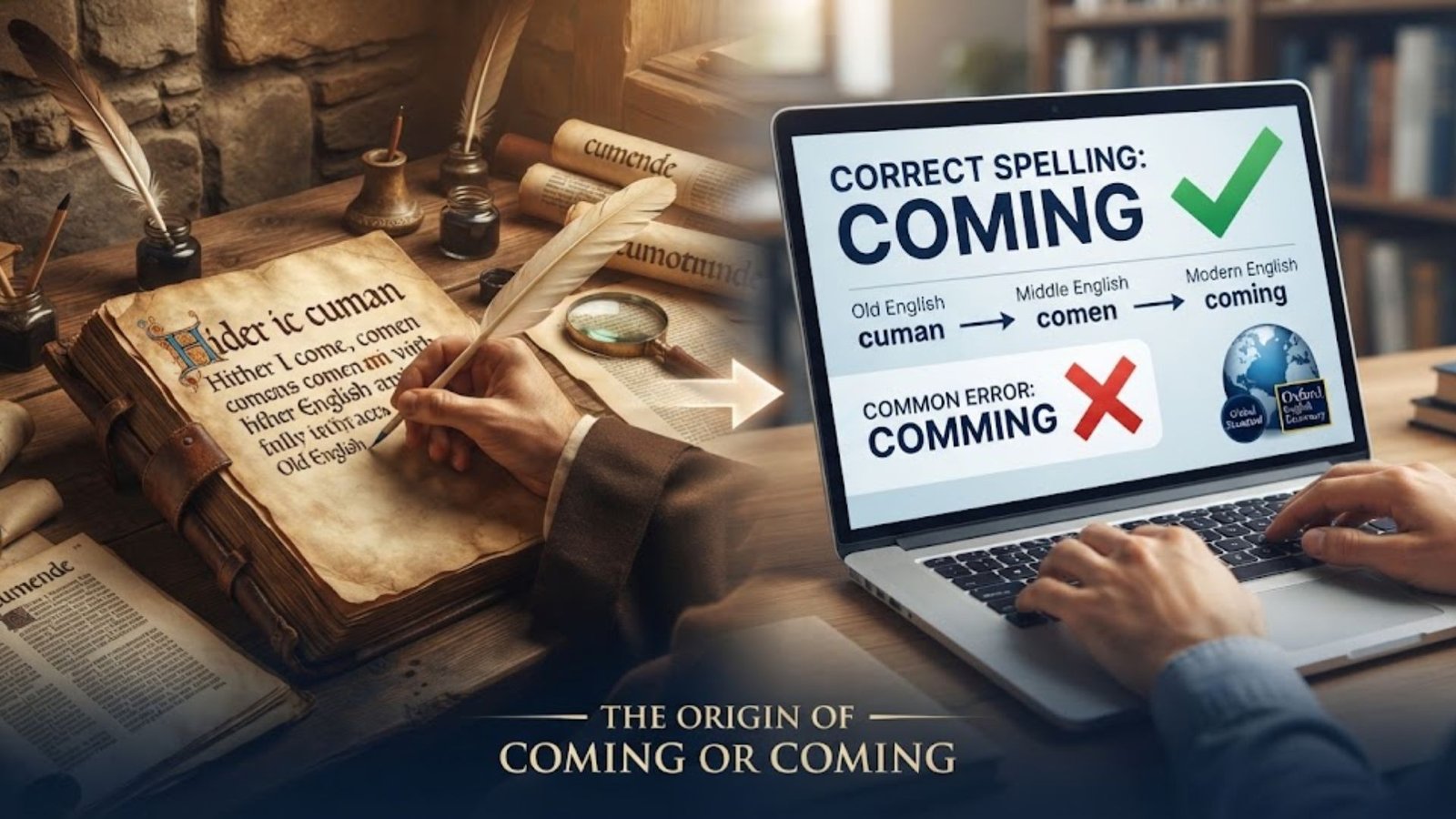
History
The word “come” has roots stretching back to Old English, where it appeared as “cuman.” Over centuries, English speakers shaped it into the word we use today. Adding “-ing” to verbs became a standard way to show ongoing action.
Old English grammar looked nothing like what we use now, but the core idea of showing motion through a verb ending survived. That thread connects modern speech all the way back to language spoken over a thousand years ago.
Development
As spelling rules solidified in modern English, a pattern formed around short verbs ending in a silent “e.” Words like “come,” “make,” and “give” all drop that final “e” before adding “-ing.” That’s exactly how “come” became “coming,” not “comeing” or “comming.”
Printing presses and early dictionaries helped lock these patterns into place. Once spelling became standardized across books and newspapers, deviations like “comming” simply stopped being an option in formal writing.
Why the Difference Exists
People confuse “comming” with “coming” mostly because of instinct. Doubling a consonant feels natural in words like “running” or “sitting.” But “come” doesn’t end in a short vowel plus consonant, so it plays by a different rule entirely.
The confusion isn’t a sign of poor grammar skills, it’s just a mismatch between two overlapping rules in English. Once you separate the two patterns in your head, this mistake tends to disappear for good.
British English vs American English Spelling
Usage Comparison
Good news here: there’s no split between British English and American English on this one. Both sides of the pond spell it the exact same way. “Coming” is standard in the UK, the US, Australia, and everywhere else English is written.
Key Insight
Unlike words such as “colour” versus “color,” this isn’t a regional spelling battle. If you’ve been holding off on writing “coming” because you’re not sure which English rulebook applies, relax. One spelling covers every English speaking country.
Regional differences in English usually pop up around vocabulary or a handful of specific endings. Core grammar rules like the drop the e rule stay consistent, which is exactly why “coming” never changes no matter where you’re writing from.
Which Spelling Should You Use?
In All Writing
Use coming everywhere: emails, texts, essays, social captions, you name it. There’s no formal or casual exception that makes “comming” acceptable. Dictionaries, style guides, and grammar checkers all agree on this.
Some writers assume casual platforms allow looser spelling, but that’s a myth worth dropping. A misspelled word reads the same whether it’s in a text message or a cover letter, it just carries different consequences.
Important Rule
Here’s the rule that solves this for good. When a verb ends in a silent “e,” drop that “e” before adding “-ing.” Come becomes coming, same as make becomes making, and write becomes writing.
This isn’t a random exception either, it’s one of the more reliable patterns in English grammar. Learn it once for “come,” and you’ll apply it correctly to dozens of other verbs without even thinking twice.
Easy Tip
Try this trick if you ever freeze up mid sentence. Say the word out loud slowly: “com-ing.” Notice it doesn’t sound like “comm-ing” with a heavier middle. Your ear can often catch what your fingers miss while typing fast.
Another trick worth trying: type the word, then pause and count the letters. Coming has six letters total, comming has seven. That tiny gap is where the mistake lives every single time.
Common Mistakes with Comming or Coming
Doubling the Letter “M”
This is the number one spelling mistake people make. Fingers move faster than brains sometimes, and that second “m” sneaks in before you notice. It happens in texts, comments, and even resumes.
Doubling consonants is such a common pattern elsewhere in English that your brain applies it automatically here too. That’s not laziness, it’s just your muscle memory working against you for once.
Ignoring the Rule
Some writers simply never learned the drop the e rule in school, or they forgot it along the way. Without that rule in mind, “comming” can look like a reasonable guess. It isn’t, but the confusion makes sense.
Grammar rules like this one rarely get taught in isolation, they usually get buried inside bigger lessons. That’s part of why so many confident writers still trip over a handful of common verbs.
Typing Errors
Autocorrect doesn’t always save you here, especially on phones where thumbs move fast. A rushed message often slips past proofreading entirely. Reading your text back before hitting send catches most of these slips.
If you write a lot for work, consider running longer pieces through a grammar checker before publishing. It won’t replace your own judgment, but it catches the small stuff you’re too close to notice.
Comming or Coming Meaning (Detailed)
Coming Meaning
As a present participle, “coming” pairs with helping verbs to show continuous tenses. “I am coming,” “they were coming,” “we will be coming” all use this same word. It always points to motion, arrival, or something about to happen.
It also works as a gerund in certain sentences, acting almost like a noun. “Her coming was a surprise to everyone” shows this exact use, where the word describes an event rather than an ongoing action.
Comming Meaning
There isn’t one. “Comming” carries no accepted definition in any dictionary. It’s simply an incorrect spelling born from a typing habit, not a separate word with its own meaning.
No major dictionary, whether Merriam Webster, Oxford, or Cambridge, lists “comming” as a valid entry. If a word doesn’t appear in any of these, that’s usually a clear sign it’s not standard English.
Comming or Coming in Everyday Examples
Conversation
“Are you coming to dinner tonight?” is a line you’ll hear constantly in casual chats. It flows naturally, and everyone recognizes it instantly. No native speaker would double that “m” while talking.
Workplace
Picture this: your manager sends a quick note before a meeting. “I’m coming down to your desk in five minutes” reads clean and professional. Typing “comming” in a work email can quietly chip away at how careful you seem.
Social Media
Captions like “Big news coming soon” show up everywhere online, from brand pages to personal accounts. Correct spelling here matters more than people realize, since typos can undercut an otherwise sharp post.
Incorrect Example
“She is comming to the meeting” looks off the second you read it closely. That extra letter breaks the rhythm of an otherwise simple sentence. Fixing it takes half a second, but skipping that check can cost you credibility.
Comming or Coming – Google Trends & Usage Data
Popularity
Search data consistently shows coming as the dominant form by a huge margin. People do search “is comming a word” or “coming vs comming,” usually because they’re double checking themselves. That alone tells you the correct spelling isn’t obvious to everyone.
Insight
The fact that this comparison gets searched at all proves something interesting. English learners and even native speakers pause on short, common words more than complicated ones. Familiarity breeds a strange kind of doubt sometimes.
A Simple Grammar Rule You Can Memorize for Good
Here’s a shortcut worth bookmarking mentally. Any verb ending in a silent “e” drops it before “-ing” gets added, unless the word ends in “ee,” “oe,” or “ye.” That covers come, hope, write, and dozens of others you use daily.
- Come → Coming
- Write → Writing
- Hope → Hoping
- Take → Taking
Notice the pattern? None of these double a consonant. That’s your quick mental checklist next time your fingers hesitate over a keyboard.
Comparison Table: Comming vs Coming
| Spelling | Correct? | Why |
| Coming | Yes | Follows the drop the e rule for present participles |
| Comming | No | Incorrectly doubles the consonant “m” |
| Comeing | No | Fails to drop the silent “e” before “-ing” |
Related Spelling Confusions You Should Know
English has plenty of these little traps hiding in plain sight. If “coming” tripped you up, you might also want to check whether it’s Pheonix or Phoenix, since that one confuses people just as often. Same goes for appendixes or appendices, where singular and plural forms trip up even confident writers.
FAQs
Is “comming” ever correct? No. It has no accepted use in standard, British, or American English.
Why do people double the “m” in coming? Mostly out of habit, since doubling consonants feels natural in similar looking words like “running.”
Is “coming” a noun or a verb? It functions as a present participle, and it can also act as a gerund noun, like in “coming and going.”
Does autocorrect always fix “comming”? Not always. Many keyboards accept fast typing errors without flagging them, so a manual check still helps.
Is “comming” a word in any dialect of English? No, not in British, American, Australian, or any other recognized dialect. It’s a spelling error rather than a regional variation.
How can I stop making this mistake permanently? Practice writing the word slowly a few times, and lean on the drop the e rule whenever you add “-ing” to a verb ending in silent “e.”
Conclusion
At the end of the day, this one’s simple. Write coming, skip comming entirely, and you’ll never second guess yourself again. Got another spelling mix up bugging you? Drop it in the comments, and let’s sort it out together.